
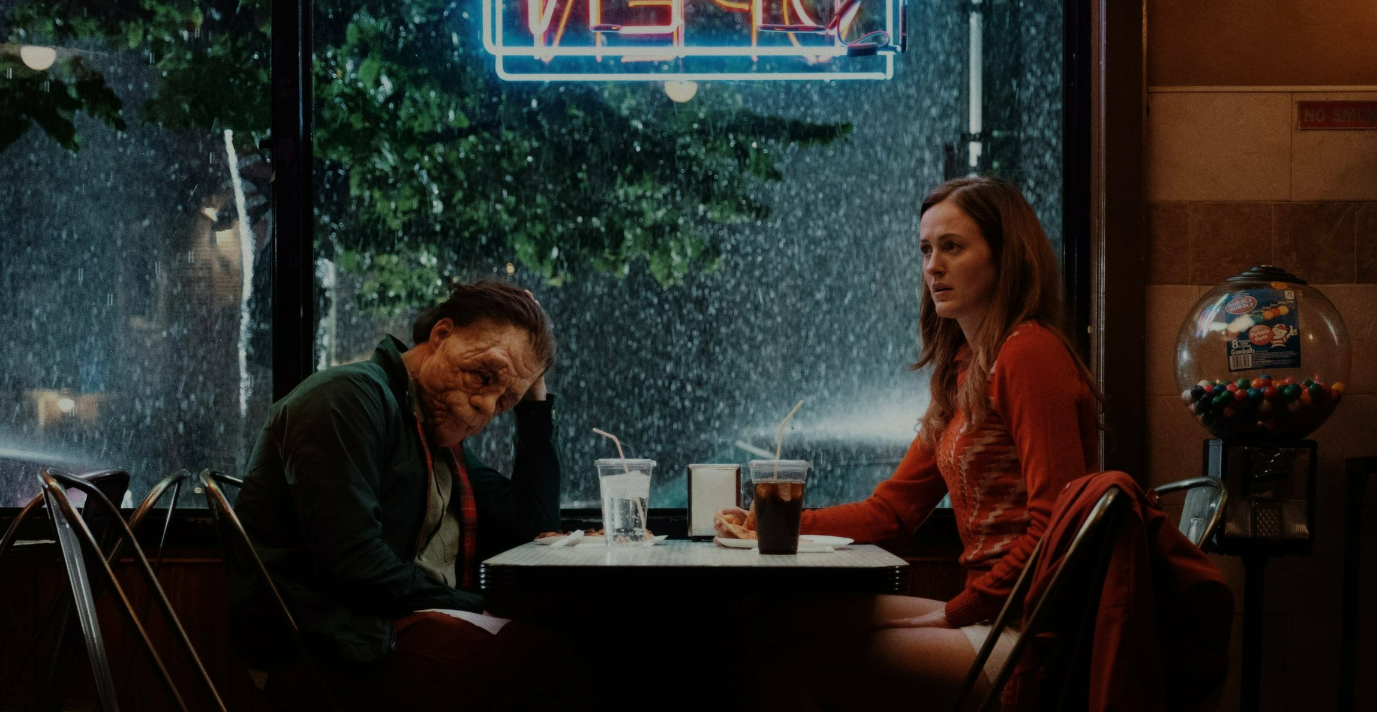
Avant de se retrouver sous la direction de Cristian Mungiu pour leur film « Fjord » qui remporta la Palme d’Or et sort cette semaine en salles, le duo Sebastian Stan & Renate Reinsve avait déjà joué ensemble deux ans plus tôt dans un petit film indépendant américain tellement passé inaperçu en France qu’il n’a pas eu droit à une sortie en salles (et est désormais disponible sur Netflix).
Aaron Schimberg signe ici une troublante fable sur l’apparence physique auprès d’un homme au visage difforme qui essaie de travailler si possible comme comédien (joué par un Sebastian Stan à la fois sympathique et dérangeant qui continue d’opter pour des rôles surprenants pour un Avenger après « Fresh » et « The Apprentice »), de sa voisine (Renate Reinsve dans son premier rôle anglophone) dramaturge, et d’un autre défiguré au comportement radicalement opposé (joué par Adam Pearson, lui-même atteint de neurofibromatose). Lorsqu’un remède médical semble pouvoir lui donner la possibilité d’effacer ses difformations, sa vie se voit bouleversée de nouveaux questionnements …
Tourné sur pellicule dans un bel éclairage urbain, « A Different Man » a surtout été applaudi pour son impressionnant travail technique de maquillage et de prothèses qui participent au vrai travail de défiguration d’une mise en scène dont les choix de cadre montrent parfois beaucoup, parfois moins, dans une volonté d’habituer le spectateur à ce personnage pour ne pas ou progressivement ne plus le dévisager. Le travail corporel de Sebastian Stan est en cela également remarquable, et en particulier ce qu’il change de sa posture ou non, une fois que son apparence évolue, révélant au fond sa nature de gêne. Mais finalement, c’est bien à travers ses nombreuses interrogations sociales que ce film se distingue.
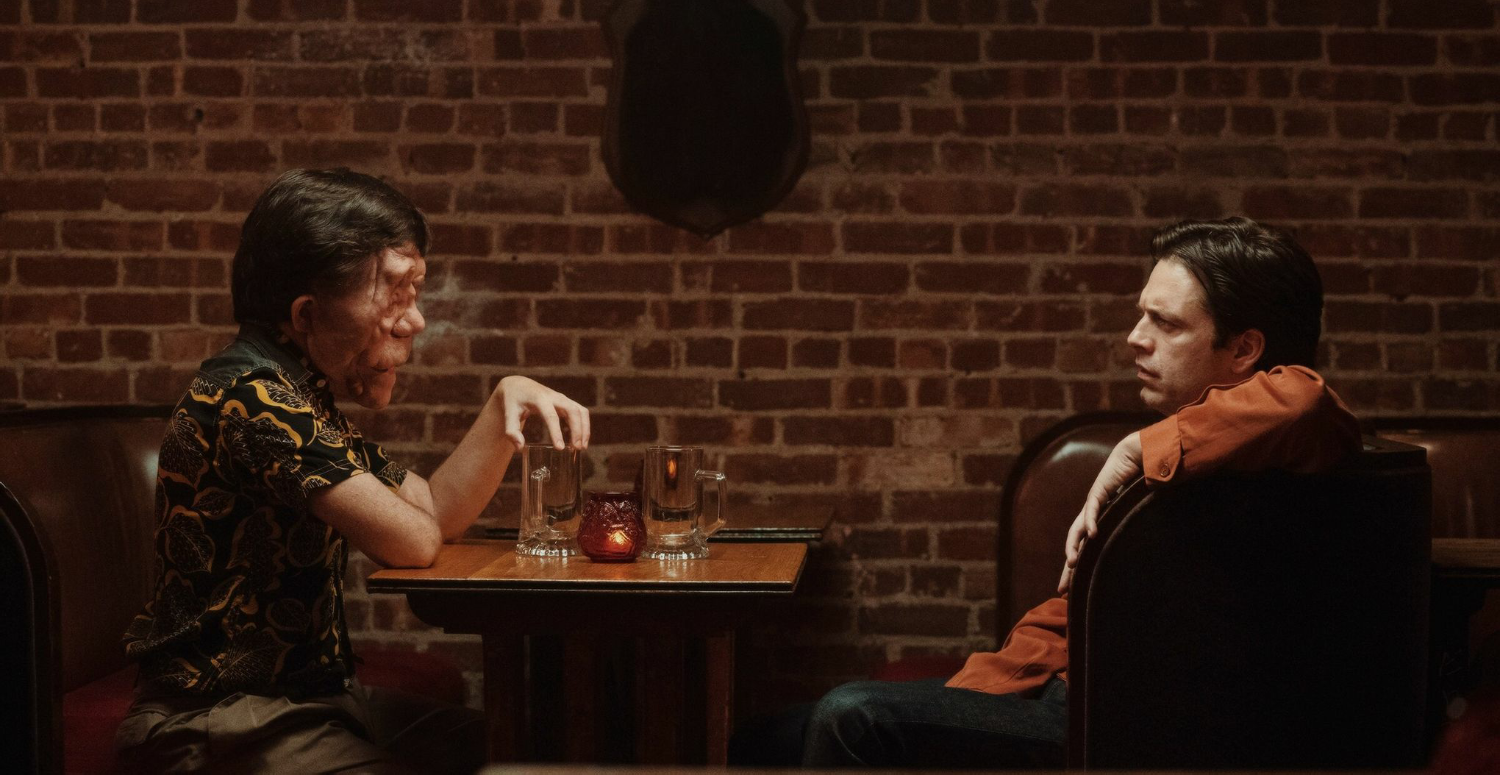
Il est vrai que l’apparence physique nourrit toutes sortes de questionnements pour tout un chacun. Mais le réalisateur, lui-même atteint de malformation avant d’être opéré, va plus loin dans cette version socialo-psychologique de « La Belle et la Bête ». Dans des variations de tons qui voient ce trio devenir tout à tour de moins en moins sympathique malgré leurs intentions louables, l’évolution de leurs dynamiques fait écho aux évolutions corporelles. La différence physique crée a priori automatiquement une différence sociale aboutissant à un besoin de se sentir ‘normal’ alors même qu’aussi différents que nous pouvons être, d’autres peuvent aller tout aussi mal.
La différence ne serait alors qu’un ressenti ? En somme, l’on désire toujours ce que l’on n’est pas. La transformation du monstre à l’humain ne devient alors pas une métaphore, un changement d’état d’esprit plus qu’autre chose ? Car au final notre apparence est-elle notre identité ? En partie certainement, mais pas intégralement. Si l’on espère changer une fois différent, le problème n’est-il alors pas plutôt la direction que nous prenons à l’heure actuelle ? Pire, au fond, n’apprécie-t-on pas la différence lorsqu’elle nous permet de nous distinguer des autres ? Que préfère-t-on alors ? Et quel prix sommes-nous prêts à payer pour ne pas n’être qu’un anonyme dans la masse ?
Il y a donc aussi une question d’attention et un besoin social derrière. Et « A Different Man » a la bonne idée d’interroger son propre processus de création scénaristique en remettant en question le processus dramaturgique des personnages. Il interroge ainsi tout autant notre rapport à la reconnaissance et à la notoriété, que la récupération des histoires d’autrui et de la souffrance par l’industrie culturelle. Est-ce mal de choisir quelqu’un dans un rôle justement pour exploiter sa difformité ? Le film explore ainsi le besoin de changer, le besoin d’être différent, et d’être un autre, à la fois sous l’angle social de l’image que l’on transmet et de ce que la société nous renvoie, mais aussi sous l’angle artistique du comédien et du choix des rôles.
Raphaël Sallenave
Aaron Schimberg delivers an unsettling fable about physical appearance, centered on a man with a disfigured face who tries, if possible, to work as an actor (played by a Sebastian Stan who is both likable and disturbing, and who continues to take on surprising roles for an Avenger following “Fresh” and “The Apprentice”), his playwright neighbor (Renate Reinsve in her first English-language role), and another disfigured man with a radically different demeanor (played by Adam Pearson, who himself has neurofibromatosis). When a medical treatment seems to offer him the chance to erase his disfigurements, his life is turned upside down by new uncertainties.
Shot on film against a beautifully lit urban backdrop, “A Different Man” was particularly praised for its impressive technical work in makeup and prosthetics, which contribute to the true disfiguring effect of a film whose framing choices sometimes reveal a lot, sometimes less, in an effort to acclimate the viewer to this character so we don’t – or gradually stop – staring at him. Sebastian Stan’s physical performance is also remarkable in this regard, particularly in how he does or does not adjust his posture once his appearance changes, ultimately revealing his underlying sense of unease. But ultimately, it is through its many social questions that this film truly stands out.
Physical appearance certainly raises all sorts of questions for everyone. But the director – who himself had a physical deformity before undergoing surgery – takes this socio-psychological take on “Beauty and the Beast” a step further. As the tone shifts and this trio becomes increasingly less likable despite their good intentions, the evolution of their dynamics mirrors physical changes. Physical difference automatically creates a social divide, leading to a need to feel “normal” – even though, as different as we may be, others may be just as unhappy.
Is the difference, then, merely a matter of perception? Ultimately, we always desire what we are not. Doesn’t the monster’s transformation into a human then become a metaphor – a change of mindset more than anything else? After all, does our appearance define our identity? Partly, certainly, but not entirely. If we hope to change once we’re different, isn’t the problem rather the direction we’re currently heading in? Worse still, deep down, don’t we appreciate difference when it allows us to stand out from others? What do we want more, then? And what price are we willing to pay to avoid being just another anonymous face in the crowd?
So, there’s also an issue of attention and a social need behind it. And “A Different Man” takes the clever approach of examining its own screenwriting process by questioning the playwright process of the characters. In doing so, it explores not only our relationship with recognition and fame, but also the cultural industry’s appropriation of others’ stories and suffering. Is it wrong to cast someone in a role precisely to exploit their physical difference? The film thus explores the need to change, the need to be different, and to be someone else – both from the social perspective of the image we project and what society reflects back to us, and from the artistic perspective of the actor and the choice of roles.
Raphaël Sallenave