La Corde au Cou
Dead Man’s Wire
2026
FR EN
Indianapolis, février 1977. Un homme ruiné par un emprunt en vient à kidnapper le fils du courtier qu’il juge responsable de sa situation. Il réclame l’annulation de sa dette et surtout des excuses officielles ! Prise d’otage suivie par les médias locaux, l’Amérique va vite se passionner pour cette affaire. Chacun choisit alors son camp. Est-il un criminel qui doit être arrêté ou simplement une victime qui réclame justice ?
Huit ans après son dernier film, Gus Van Sant est de retour en salles avec ce fait divers historique dont il tire une comédie dramatique qui joue étonnamment sur un ton décalé dès le départ quand bien même cette même histoire aurait très bien pu être racontée d’un point de vue beaucoup plus sombre, dramatique et tendu. Ici, le réalisateur de « Will Hunting », « Elephant » (Palme d’Or) et « Promised Land » dresse un portrait ambivalent du preneur d’otage, sans en faire l’apologie et sans jamais ignorer la violence de ses actes, mais en jouant en permanence sur les contrastes de cet homme ouvert aux autres, foncièrement gentil et respectueux. Mêlant empathie et sentiment politique, il se concentre ainsi sur sa relation avec l’otage dans un mélange déconcertant de cordialité et sincérité d’un côté, et de contrainte et hargne de l’autre.
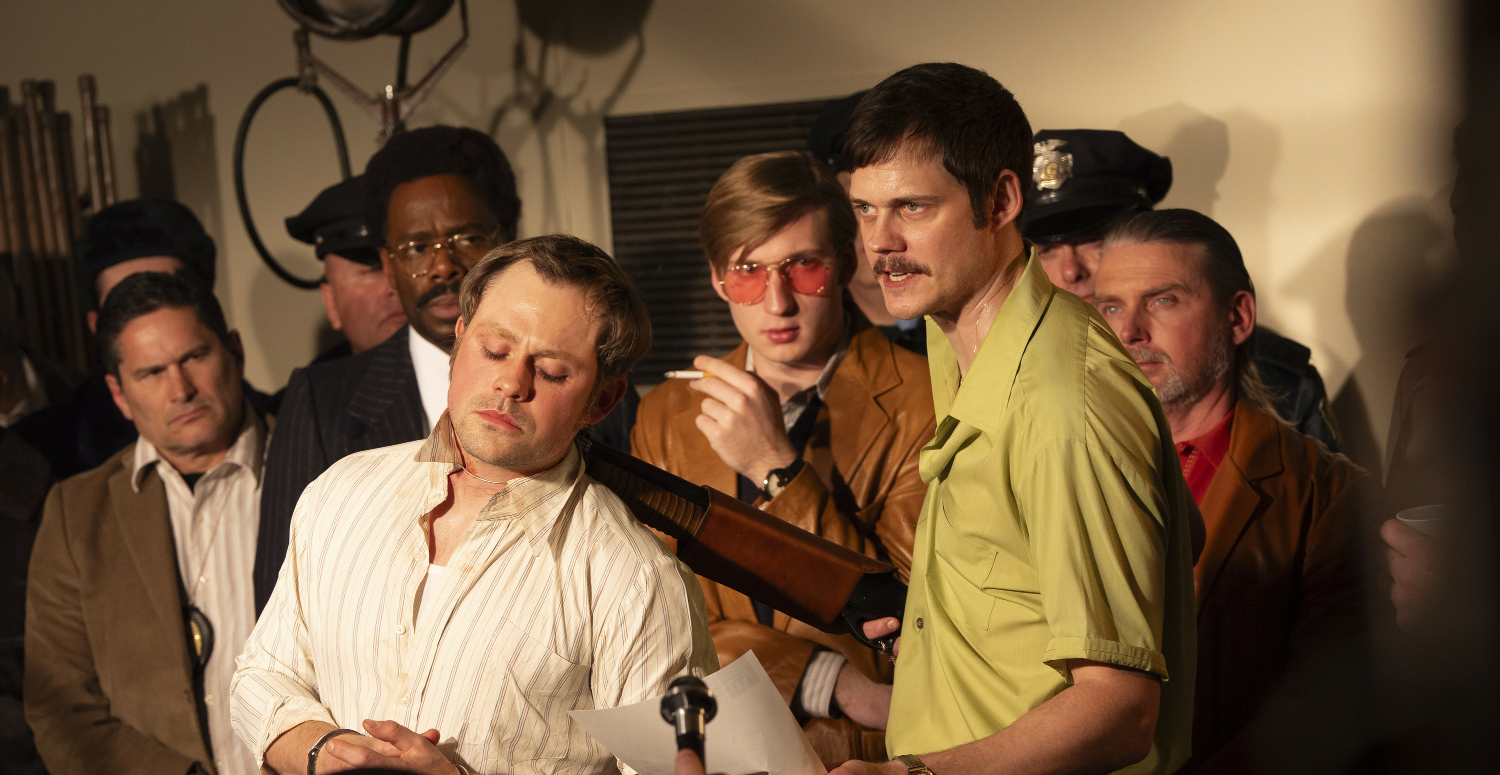
Comme toujours très bon dans la direction d’acteurs, il s’appuie ici sur l’excellente performance de Bill Skarsgård (Ça ; Nosferatu) qui campe un anti-héros désarmant, parfait de nervosité mal contrôlée, à la fois drôle et pathétique, face à son otage tiraillé entre une peur relativement maîtrisée et un syndrome de Stockholm naissant, incarné avec justesse par Dacre Montgomery (Stranger Things), aux côtés de la jeune Myha’la Herrold et des vétérans Colman Domingo et Al Pacino. Gus Van Sant prolonge ce décalage jusque dans une mise en scène jouant de couleurs fades plaquant ses personnages dans un décor endormi et sous tension anesthésiée – à l’image du récent « The Mastermind » qui dépouillait aussi son époque d’un vernis habituellement plus mélancolique – et traite ses scènes d’action avec distance en y insérant des photos en noir et blanc de reconstitution de la scène.
La distance semble d’ailleurs être le ton appliqué à ce récit sans pathos ni morale qui ne développe jamais trop ni les motivations de notre anti-héros, ni le contexte des faits pour mettre en scène une histoire qui pose des questions sans proposer vraiment de pistes de réponses, une histoire qui interroge sans vraiment prendre parti. Résultat, on ne sait trop quoi penser du traitement d’un tel sujet – et c’est volontaire, à l’heure où l’arrestation de Luigi Mangione défraye la critique par exemple. Moins porteur d’un message que ses précédents films, c’est le portrait d’un homme qui réclame réparation dans un geste qui est, au fond, politique même s’il ne le formule pas ainsi, et que le film ne traite par conséquent pas ainsi également – tout en portant une certaine énergie de révolte notamment dans la B.O., en transformant le présentateur télévisé en DJ afro-américain dans un geste de convergence des luttes, et en auscultant la transformation de l’actualité en spectacle dans les médias télévisés.
Raphaël Sallenave
Indianapolis, February 1977. A man ruined by a loan kidnaps the son of the broker he holds responsible for his situation. He demands that his debt be forgiven and, above all, an official apology! With the local media covering the hostage situation, America quickly becomes captivated by the case. Everyone then chooses a side. Is he a criminal who must be arrested, or simply a victim demanding justice?
Eight years after his last film, Gus Van Sant returns to theaters with this historical news story, which he has turned into a comedy-drama that takes a surprisingly offbeat tone from the very start – even though the same story could very well have been told from a much darker, more dramatic, and tension-filled perspective. Here, the director of “Good Will Hunting”, “Elephant” (Palme d’Or), and “Promised Land” paints an ambivalent portrait of the hostage-taker, without glorifying him and without ever ignoring the violence of his actions, but constantly drawing on the contrasts of this man who is open to others, fundamentally kind, and respectful. Blending empathy and political sentiment, he thereby focuses on his relationship with the hostage in a disconcerting mix of cordiality and sincerity on one hand, and coercion and hostility on the other.
As good as ever at directing actors, he relies here on the excellent performance of Bill Skarsgård (It; Nosferatu), who portrays a disarming anti-hero, perfectly embodying poorly controlled nervousness – both funny and pathetic – as he faces his hostage, torn between relatively controlled fear and a budding Stockholm syndrome, vividly portrayed by Dacre Montgomery (Stranger Things), alongside the young Myha’la Herrold and industry veterans Colman Domingo and Al Pacino. Gus Van Sant extends this dissonance into a visual style that plays with muted colors, placing his characters in a sleepy setting under a numbing tension – much like the recent “The Mastermind”, which also stripped its era of its usually more melancholic glow – and handles its action scenes with distance by inserting black-and-white photographs of the recreated scene.
This sense of distancing seems to be the tone of this story, which is devoid of pathos or moralizing; it never delves too deeply into either our anti-hero’s motivations or the context of the events, instead presenting a narrative that raises questions without really offering any answers, a story that probes without truly taking sides. As a result, we’re not quite sure what to make of the handling of such a subject – and this is intentional, at a time when Luigi Mangione’s arrest is generating controversy, for example. Less message-driven than his previous films, this is the portrait of a man demanding compensation in a gesture that is, at its core, political even if he doesn’t frame it that way, and which the film consequently doesn’t treat as such either – while conveying a certain rebellious spirit, particularly in the soundtrack, by turning the TV anchor into an African-American DJ in a move that merges struggles, and by examining how the news is turned into a show in the television media.
Raphaël Sallenave