Après un premier volet au final plus inégal qu’ambitieux, Antonin Baudry conclut son diptyque de manière bien plus convaincante. Là où « L’Âge de fer » peinait à faire cohabiter ses différentes intrigues et multipliait les ruptures de ton, « J’écris ton nom » trouve un équilibre narratif nettement plus maîtrisé. Les enjeux s’entrecroisent avec davantage de fluidité, le montage paraît plus naturel, l’action plus immersive, et ces 2h40 offrent une belle séance de cinéma populaire qui assume pleinement son ambition de blockbuster historique à la française.
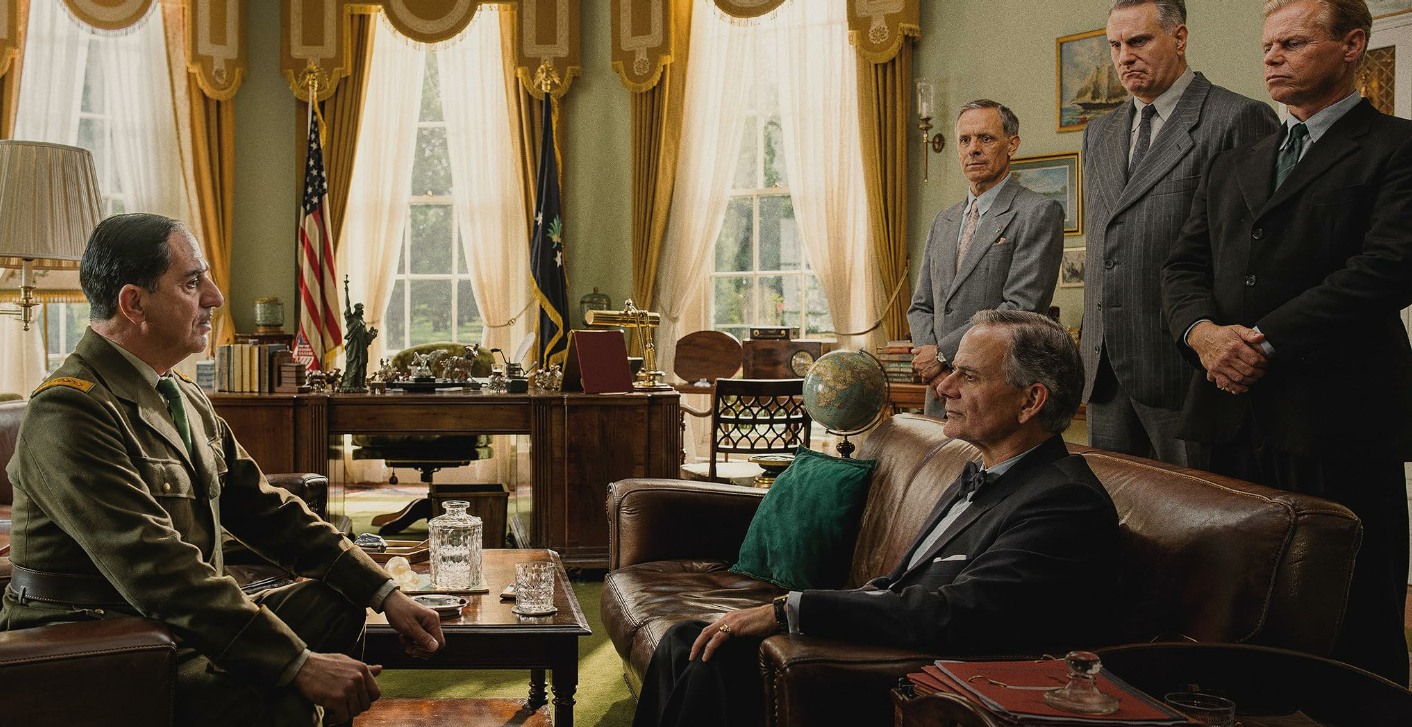
Cette fois, le conflit ne se joue presque plus contre les Allemands, judicieusement laissés hors champ. Le véritable affrontement devient politique. Face à un Roosevelt désireux de réduire la France à un simple protectorat américain et à une Résistance profondément divisée, de Gaulle ne cherche plus seulement à gagner la guerre du présent, mais aussi celle du futur : il tente d’empêcher la disparition de la France comme nation souveraine. La guerre se mène ainsi autant dans les bureaux de Londres et d’Alger que sur les champs de bataille nord-africains, où la campagne de Leclerc rappelle que le destin de l’Europe s’est aussi joué de l’autre côté de la Méditerranée.
La complicité contrariée que De Gaulle entretient avec Churchill est à nouveau une réussite du film, entre tension diplomatique, admiration réciproque et humour, au gré désormais d’une confrontation franco-française arbitrée outre-Atlantique face à un Thierry Lhermitte excellemment cabotin, voire caricatural dans son interprétation d’un Giraud pantin offrant un bien meilleur dosage dans l’équilibre entre comique et sérieux que dans le premier volet.
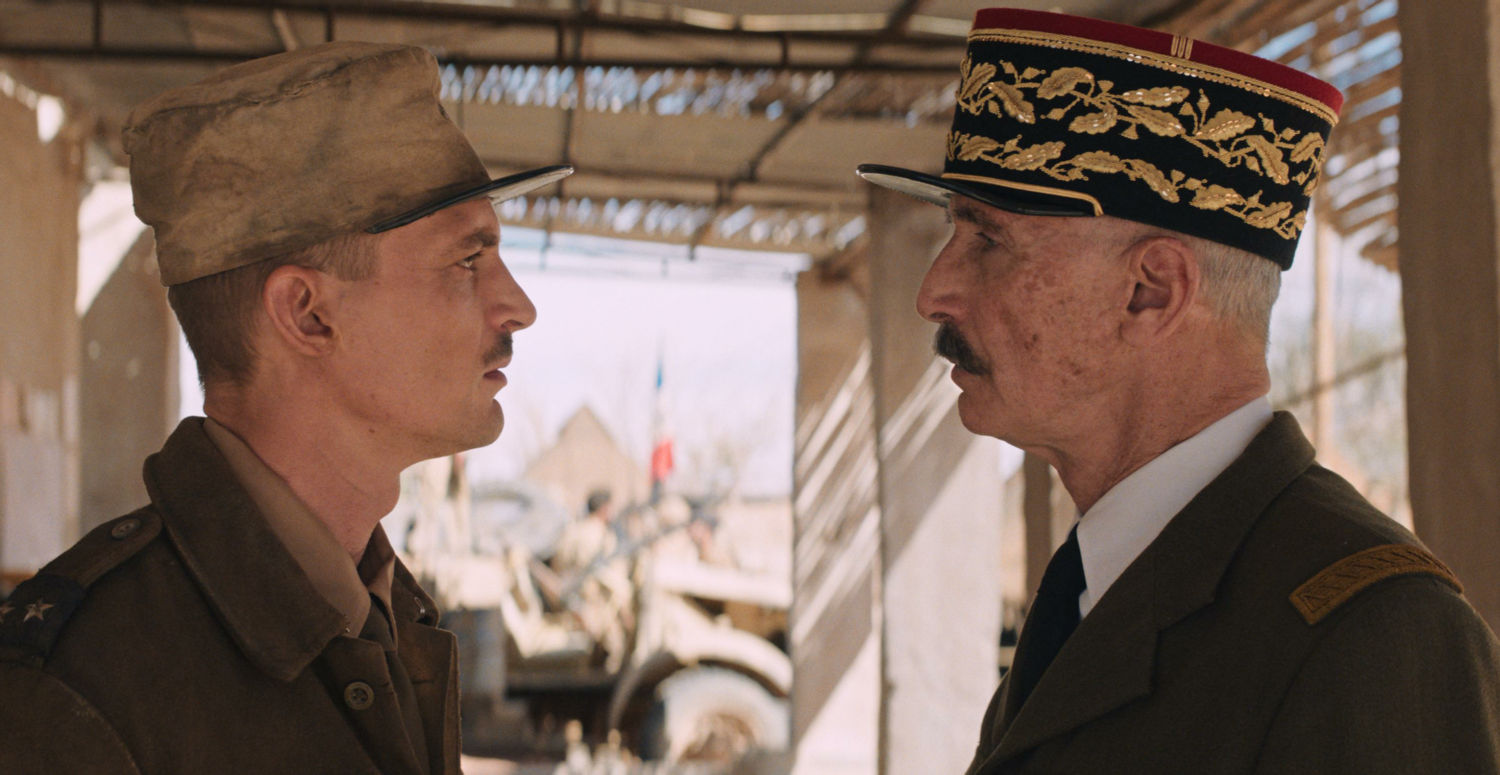
Mais si ce second opus fonctionne mieux, c’est avant tout par ses enjeux interconnectés et la circulation entre ses différents lieux d’action qui voient par exemple éclore la figure du général Leclerc incarnée avec force par Niels Schneider dans un rôle obstiné, insubordonné et profondément libre, qui devient un véritable second personnage dont la trajectoire nourrit le portrait du Général. L’intrigue métropolitaine sur un Jean Moulin cherchant à fédérer les réseaux de résistance gagne également en intérêt tant son action dialogue enfin avec les événements de Londres et d’Alger, même si cette trame reste trop peu développée. De manière générale le portrait de la Résistance reste la faiblesse récurrente de ces deux volets à l’image du personnage fictif d’Anamaria Vartolemei toujours aussi artificiel – censé représenter plusieurs figures féminines – sans jamais lui offrir le moindre arc narratif ou utilité scénaristique.
Si la dynamique est sensiblement la même entre les deux opus, le dosage entre les tons et l’équilibrage narratif accouchent donc d’un ressenti bien différent offrant une conclusion sincèrement satisfaisante à ce double portrait national. Car, en choisissant d’achever son récit non pas à Berlin mais à Paris, Antonin Baudry rappelle finalement que son sujet n’était jamais la guerre elle-même, mais bien la renaissance politique de la France. Si quelques raccourcis historiques demeurent et que la mise en scène conserve un académisme parfois un peu scolaire sans jamais vraiment laisser le temps aux situations et aux ambiances de respirer, « La Bataille de Gaulle » – pris dans sa globalité – constitue une fresque certes imparfaite mais qui réussit in fine à conjuguer spectacle populaire et mémoire nationale.
Raphaël Sallenave
After a first installment that was ultimately more flawed than promising, Antonin Baudry wraps up his two-part epic in a far more convincing manner. Whereas “Tilting Iron” struggled to weave its various storylines together and featured frequent shifts in tone, “Sovereign Edge” strikes a much more masterful narrative balance. The storylines intertwine more smoothly, the editing feels more natural, the action is more immersive, and these 2 hours and 40 minutes offer a delightful piece of popular cinema that fully embraces its ambition as a French-style historical blockbuster.
This time, the conflict is hardly being fought against the Germans, who are wisely left out of the picture. The real battle has become political. Faced with a Roosevelt eager to reduce France to a mere American protectorate and a deeply divided Resistance, de Gaulle is no longer seeking merely to win this war, but also the one to come: he is trying to prevent the disappearance of France as a sovereign nation. The war is thus fought as much in the offices of London and Algiers as on the battlefields of North Africa, where Leclerc’s campaign serves as a reminder that the fate of Europe was also decided on the other side of the Mediterranean.
The strained yet strong relationship between De Gaulle and Churchill is once again a highlight of the film, navigating diplomatic tension, mutual admiration, and humor, now subject to a French-French dispute arbitrated from across the Atlantic, pitted against a Thierry Lhermitte who is superbly hammy – even caricature-like – in his portrayal of Giraud as a puppet, striking a far better balance between comedy and seriousness than in the first installment.
But if this second installment works better, it is above all because of its interconnected storylines and the back-and-forth between its various locations, which, for example, see the emergence of General Leclerc – powerfully portrayed by Niels Schneider in a role that is stubborn, insubordinate, and deeply free – who becomes a true supporting character whose journey fuels the portrait of the General. The domestic plotline – centered on Jean Moulin’s efforts to unite the resistance networks – also becomes more compelling as his actions finally connect with the events in London and Algiers, even if this storyline remains underdeveloped. Overall, the portrayal of the Resistance remains the recurring weakness of these two parts, as exemplified by the fictional character of Anamaria Vartolemei, who remains as artificial as ever – supposedly representing several female figures – without ever being given the slightest story arc or narrative purpose.
While the qualities and flaws are essentially the same in both films, the feeling is not. The tone and narrative balance ultimately create a very different experience, offering a genuinely satisfying conclusion to this dual national portrait. For by choosing to conclude his story not in Berlin but in Paris, Antonin Baudry ultimately reminds us that his real subject was never the war itself, but rather France’s political rebirth. While a few historical oversimplifications remain and the direction retains a style that is at times somewhat academic, never really allowing the situations and atmospheres time to breathe, “De Gaulle” – taken as a whole – is a historical epic that, while certainly imperfect, nonetheless succeeds in ultimately combining popular entertainment with national legacy.
Raphaël Sallenave