Mārama
2025/2026

FR EN
Mārama : en te reo māori, ce mot signifie « clarté », « lucidité ». C’est aussi le nom de l’héroïne de ce thriller d’épouvante historique néo-zélandais. Premier long-métrage de Taratoa Stappard, « Mārama » raconte l’histoire d’une femme māorie qui, au cours d’un troublant séjour dans le Yorkshire du Nord en 1859, se voit révélée la puissance de son identité autochtone face à l’emprise britannique.
Qualifié par le réalisateur lui-même de « tout premier film d’horreur gothique māorie », « Mārama » se trouve en effet à la croisée de plusieurs genres et sous-genres horrifiques, là où se combinent violences psychologiques, physiques, culturelles et spirituelles. Par cet intelligent (quoique peut-être par moments abscons) mélange, le récit met assurément en lumière le profond sentiment d’oppression et les traumatismes vécus par les Māoris depuis la colonisation, ce peuple ayant été, comme tant d’autres, massivement et brutalement déculturé.
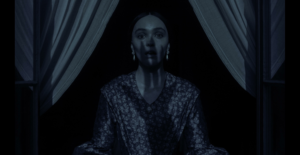
Le personnage de Mārama erre ainsi dans un vaste manoir, souvent de nuit, où elle croise les âmes et les fantômes de sa communauté meurtrie. Les décors et les éclairages sont par conséquent majoritairement teintés d’un bleu sombre, hormis durant les scènes d’extérieur où là, la lumière, froide et blafarde, éblouit et effraye d’une autre façon. La musique alterne aussi entre des sons « britanniques » stridents et des chants māoris mélancoliques, ajoutant du contraste entre deux mondes qui se confrontent. La scène de loin la plus remarquable de ce long-métrage est donc celle de la fête, où Mārama étouffe et explose face à la réappropriation glauque et extravagante de sa culture, alors que lui reviennent depuis plusieurs jours par fragments et saccades des souvenirs rapportés et hallucinatoires des atrocités commises sur ses proches.
Par le prisme d’un terrible drame personnel, « Mārama » se veut toutefois aussi narrer le récit d’une vengeance : celle d’une femme qui parvient finalement à se libérer du carcan patriarcal et colonial, qui, « en marchant à reculons vers l’avenir » selon l’adage māori (« Ka mua, ka muri ») venge sa famille et son peuple au nom de l’intégrité de ses ancêtres et de ses descendants.
Axel Chevalier
Mārama: in Māori, this word means “clarity” or “lucidity.” It is also the name of the heroine of this New Zealand historical horror thriller. Taratoa Stappard’s debut feature film, indeed tells the story of a Māori woman who, during a troubling stay in North Yorkshire in 1859, discovers the power of her indigenous identity in the face of British domination.
Described by the director himself as the “very first Māori Gothic horror film,” “Mārama” stands at the intersection of several horror genres and subgenres, where psychological, physical, cultural, and spiritual violence converge. Through this intelligent (though perhaps at times abstruse) blend, the narrative unquestionably highlights the profound sense of oppression and the traumas experienced by the Māori since colonization, a people who, like so many others, have been massively and brutally deculturized.
The character of Mārama thus wanders through a vast mansion, often at night, where she encounters the souls and ghosts of her wounded community. The sets and lighting are consequently mostly tinged with a dark blue, except during the outdoor scenes, where the cold, pale light dazzles and frightens in a different way. The music also alternates between strident “British” sounds and melancholic Māori songs, adding contrast between two clashing worlds. By far the most remarkable scene in this film is therefore the party scene, where Mārama feels suffocated and erupts in the face of the dismal and grotesque co-optation of her culture, while for several days now, fragmented and jarring memories – both reported and hallucinatory – of the atrocities committed against her loved ones have been flooding back to her.
Through the lens of a horrific personal tragedy, “Mārama” also aims to tell a story of vengeance: that of a woman who finally manages to free herself from the patriarchal and colonial straitjacket, who, “walking backward toward the future” according to the Māori adage (“Ka mua, ka muri”), avenges her family and her people in the name of the integrity of her ancestors and her descendants.
Axel Chevalier