
Trois lettres – et même deux en hébreu : O-U-I / כ-ן. Comment un mot si court et si simple peut-il cacher l’immense complexité d’une société aussi déchirée que celle qui peuple l’État d’Israël, dans un contexte géopolitique mondial où l’image de ce pays est considérablement et violemment controversée, tant en dehors qu’au sein de ce petit territoire ? C’est à cette question éminemment politique que s’attaque le réalisateur Nadav Lapid, pris en étau entre un appel international au boycott d’Israël et une prise de position qui lui a attiré les foudres d’un gouvernement en guerre et ultra-nationaliste.
Écrit initialement avant le massacre du 7 octobre 2023, le cinquième long-métrage du réalisateur israélien vivant désormais en France a dû faire face, comme le reste du monde, aux évènements abominables qui se sont perpétrés depuis cette date. Ironie sordide de l’histoire, le cinéaste, qui a tout de même longuement réfléchi sur la nécessité de produire ce film, n’a eu qu’à réécrire certains éléments de son scénario pour qu’il colle à l’actualité horriblement réelle du Proche-Orient. Or, « Oui » n’est pas un documentaire : c’est un portrait saisissant de la société israélienne, miroir dans lequel nombre d’Israéliennes et Israéliens ne peuvent se regarder.
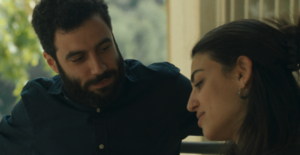
Mais quel est le synopsis de ce film ? C’est l’histoire de Y. (prononcez « Youd »), musicien-troubadour attitré de la haute société israélienne avec sa femme danseuse Yasmine, à qui l’on va proposer d’écrire un nouvel hymne patriotique à la gloire de la victoire [hypothétique] d’Israël dans sa guerre contre l’ennemi. Et bien sûr cela va poser question.
Cependant, si le sujet est déjà frappant, la façon dont il est exposé l’est d’autant plus. Divisé en trois chapitres de taille inégale (« La Belle Vie », « Le Chemin », « La Nuit »), « Oui » débute par une séquence outrancière qui donne tout de suite, semble-t-il, le ton extravagant voire obscène du long-métrage. Il n’en est néanmoins rien, puisque beaucoup de choses se passent en deux heures et demie de film.

Y. et Yasmine, d’abord explicitement dépeints en extravertis bouffons des rois, sont ainsi peu à peu présentés sous un angle plus sérieux. Leur tempérament – en particulier celui de Y. – fougueux, spontané et un brin chtarbé laisse progressivement le champ libre à des introspections plus terre-à-terre puis profondes. Ils sont par exemple des parents aimants, inquiets du sort de leur jeune fils – né d’ailleurs le lendemain du massacre – et au regard de leurs métiers et relations, se posent des questions sur l’avenir et surtout la place de leur famille.
Mais « Oui », à l’instar de son personnage phare de Y., constitue aussi un long-métrage incroyablement vif et créatif. La mise en scène – que d’aucuns pourraient juger peu raffinée – comprend une série de petites folies qui font sourire quoiqu’interpellent (des légers effets spéciaux çà et là, des danses de caméras, un brisement brutal du quatrième mur), mais aussi de grandes folies qui cette fois-ci marquent voire heurtent (des symboliques fortes pour transmettre des messages politiques, la vidéo réelle d’une chanson de propagande, un hors-champ relevant une dichotomie effrayante entre une action et son lieu).
Même chose pour les séquences et scènes qui, pour la plupart, témoignent d’une certaine personnalité voire prise de position du réalisateur sur les sujets qu’il traite. De décalée et décadente (les différentes fêtes, la pluie de pierres), le film passe par une ambiance plus poétique et insouciante (les échappées en ville et dans le désert, le jeu du piano à deux) pour finalement troubler avec des situations clairement plus pesantes et éprouvantes (le monologue de la voiture, le baiser sur la colline).
Cette diversité et ces nombreux changements de registres – incarnés par des actrices et acteurs qui crèvent l’écran (Ariel Bronz pour Y., Efrat Dor pour Yasmine, Naama Preis pour Leah, Alexeï Serebriakov pour le milliardaire, et d’autres encore) – dérange. Et c’est le but. Car malgré un ton ouvertement satirique, « Oui », demeure une histoire tragiquement réelle d’aveuglement. D’aveuglement face à soi-même, face à ses proches, face à son monde.

Y. (et, dans une moindre mesure, Yasmine), c’est avant tout un personnage qui s’est perdu dans des choix qu’il n’a pas toujours faits en étant conscient des conséquences. Il regrette ainsi certains actes mais en commet d’autres totalement absurdes dans l’optique de s’oublier, d’oublier sa famille, d’oublier sa vie, d’oublier son pays. Pour Y., dire oui, c’est accepter de se soumettre, et donc d’être libre dans cette soumission. Mais à force de dire oui à tout, l’on finit par se travestir, par se prostituer, par oblitérer ce qui pourtant se passe sous sa fenêtre : un enfant qui grandit tout en ignorant, une corruption qui pourrit les âmes et les gens, une asymétrique guerre génocidaire qui écume des vies quotidiennement.
Souffrant, d’un côté, d’une véhémente et officielle opposition du gouvernement israélien (et de leurs soutiens), d’un autre, d’un boycott et/ou d’une censure anti-israélienne dans nombre de pays, « Oui » tranche certes nettement au regard de son positionnement vis-à-vis de l’abominable et atroce conflit qui meurtrit chaque jour et depuis des décennies le Proche-Orient. Mais, sans révolutionner fondamentalement le septième art, le long-métrage rompt aussi avec une forme de cinéma quelquefois trop léché, tant sur la forme que sur le fond. L’on ne peut et ne doit pas par ailleurs le réduire à sa nationalité, à sa couleur politique ou à son sujet, parce que « Oui » soulève des réflexions existentielles et philosophiques plus poussées sur la question de l’exil, triste leitmotiv de la religion juive et plus généralement de l’histoire humaine. Le film dénonce par conséquent autant qu’il déplore l’état actuel des choses, alors qu’un simple mot de trois ou deux lettres (N-O-N / ל-א) pourrait parfois changer la face du monde. Et ce alors même qu’à cette quête-fuite qu’est l’exil, nous avons déjà toutes et tous envisagé de dire… oui.
Axel Chevalier
Three letters – and only two in Hebrew: Y-E-S / כ-ן. How can such a short and simple word capture the immense complexity of a society as divided as that of the State of Israel, in a global geopolitical landscape where the country’s image is highly and violently controversial, both outside and within this small territory? This eminently political question is tackled by director Nadav Lapid, caught between an international call for a boycott of Israel and a stance that has drawn the wrath of a warring and ultra-nationalist government.
Originally written before the massacre of October 7, 2023, the fifth feature by the Israeli director now living in France had to deal, like the rest of the world, with the horrific events that have taken place since that date. In a cruel twist of fate, the filmmaker, who had long reflected on the necessity of producing this film, only had to rewrite a few parts of his script to make it fit with the horribly real events unfolding in the Middle East. However, “Yes” is not a documentary: it is a striking portrait of Israeli society, a mirror in which many Israelis cannot see themselves.
But what is the plot of this film? This is the story of Y. (pronounced “Youd”), a musician and troubadour who is the official entertainer of Israeli high society, and his wife Yasmine, a dancer. They are asked to write a new patriotic anthem celebrating Israel’s [hypothetical] victory in its war against the enemy. And of course, this is going to raise questions.
However, while the subject matter is already striking, the way it is depicted is even more so. Divided into three chapters of unequal length (‘The Good Life’, ‘The Path’, ‘The Night’), “Yes” begins with an outrageous sequence that immediately sets what appears to be the extravagant, even obscene tone of the film. However, this is not the case, as a lot happens in the two and a half hours of that movie.
Y. and Yasmine, initially portrayed explicitly as extroverted court jesters, are gradually presented in a more serious light. Their temperament – especially Y.’s – fiery, spontaneous, and slightly crazy, gradually gives way to more down-to-earth and then profound introspection. For example, they are loving parents, concerned about the fate of their young son – born the day right after the massacre – and, given their jobs and relationships, they wonder about the future and, above all, the fate of their family.
But “Yes”, like its main character Y., is also an incredibly lively and creative film. The direction – which some might consider a little crude – includes a series of little quirks that make you smile but also make you think (minor special effects here and there, camera dances, a sudden breaking of the fourth wall), but also some major eccentricities that this time make an impression or even shock (strong symbolism to convey political messages, real video footage of a propaganda song, an off-screen moment highlighting a frightening duality between an action and its location).
The same goes for the sequences and scenes, most of which reveal a certain personality or even stance on the part of the director regarding the subjects he tackles. From offbeat and decadent (the various parties, the rain of stones), the film moves on to a more poetic and light-hearted mood (the escapades in the city and the desert, the piano duet) before finally unsettling the viewer with clearly more heavy and distressing situations (the monologue in the car, the kiss on the hill).
This diversity and these numerous shifts in tone—embodied by actors who light up the screen (Ariel Bronz as Y., Efrat Dor as Yasmine, Naama Preis as Leah, Alexei Serebriakov as the billionaire, and others)—are unsettling. And that’s the point. Because despite its openly satirical tone, “Yes” remains a tragically real story of blindness. Blindness to oneself, to one’s loved ones, to one’s world.
Y. (and, to a lesser extent, Yasmine) is above all a character who has lost his way through choices he did not always make fully aware of the consequences. He regrets certain actions but commits others that are completely absurd in an attempt to forget himself, his family, his life, and his country. For Y., saying yes means accepting to submit, and therefore to be free in that submission. But by saying yes to everything, you end up disguising yourself, prostituting yourself, obliterating what is happening right under your window: a child growing up in ignorance, corruption rotting souls and people, an asymmetrical genocidal war that takes lives every day.
Facing fierce and official opposition from the Israeli government (and its supporters) on the one hand, and anti-Israeli boycotts and/or censorship in many countries on the other, “Yes” certainly takes a clear stance on the appalling and atrocious conflict that has been ravaging the Middle East every day for decades. But without fundamentally revolutionizing the art of cinema, the movie also breaks with a type of filmmaking that is sometimes overly polished, both in style and substance. Furthermore, it cannot and should not be reduced to its nationality, political leanings, or subject matter, because “Yes” raises more profound existential and philosophical reflections on the question of exile, a sad leitmotif of the Jewish religion and, more generally, of human history. The film therefore condemns and deplores the current state of affairs, when a simple two- or three-letter word (N-O / ל-א) could sometimes change the face of the world. And yet, in this quest-escape that is exile, we have all already considered saying… yes.
Axel Chevalier