La Voix de Hind Rajab
Ṣawt Hind Rajab – صوت هند رجب
(The Voice of Hind Rajab)
Lion d’Argent (Grand Prix) – Venise
Grand Prix – Gand
Prix du Jury – Chicago & Pessac
Prix du Public – San Sebastián
2025
FR EN
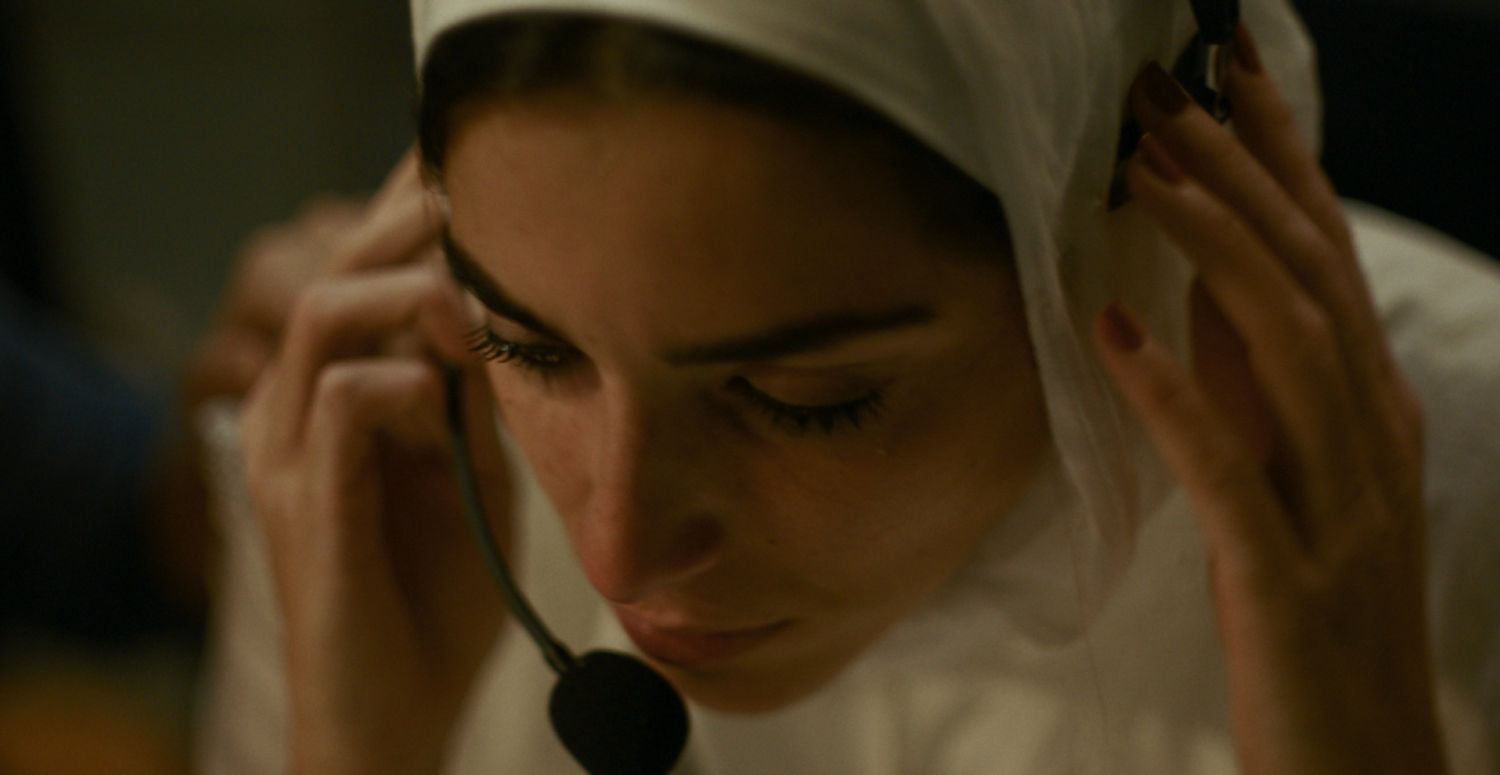
Comment raconter le réel si irracontable ? Après l’inventive hybridité des « Filles d’Olfa », Kaouther Ben Hania continue de mêler réalité et fiction dans son nouveau film nous plongeant cette fois dans l’enfer que traverse les civils à Gaza. Elle recrée les échanges téléphoniques entre une fillette coincée dans une voiture à proximité des troupes de Tsahal, et les permanents du Croissant rouge qui se relaient inlassablement au téléphone pour la soutenir et la réconforter pendant qu’ils s’efforcent en parallèle de mettre en place une opération humanitaire. Les enregistrements audios des conversations téléphoniques y sont authentiques quand les femmes et les hommes du Croissant rouge auxquels la fillette parle, sont interprétés eux par des acteurs palestiniens. L’intégralité de l’action est donc décrite par la voix de la fillette, un matériau authentique autour duquel la réalisatrice tunisienne construit son film dans un huis-clos oppressant au sein du centre d’appels humanitaire de Ramallah où la vie de la gamine est, littéralement, suspendue à un fil.
Explorant à nouveau la frontière entre documentaire et fiction, Kaouther Ben Hania se limite ainsi à ce cadre exclusivement sonore qui reprend les codes de la tragédie classique avec son unité de lieu, de temps et d’action. C’est un parti pris qui ne cherche aucunement à ajouter de l’horreur visuelle au réel resté en hors-champ, pour s’appuyer uniquement sur l’imagination du spectateur dans une scénographie vitrée jouant de la transparence des espaces entre ses protagonistes pour y montrer l’écoute. A la fois la dimension centrale et vitale de ces paroles sont ainsi retranscrites à l’écran dès l’ouverture lorsqu’une onde bleue vient strier l’obscurité de l’écran noir pour y laisser apparaître une ligne floue entre l’encéphalogramme et l’enregistrement vocal : une ligne de vie. Bien que moins riche en mise en scène que « Les Filles d’Olfa », « La Voix de Hind Rajab » pousse ensuite l’hybridation jusque dans une scène synchronisant la réelle voix de la fillette, les réactions des vrais humanitaires et le jeu des acteurs dans un enregistrement des images et des paroles qui devient la seule arme de ce film de guerre.
Ce choix de huis-clos, propre à faire monter la tension, montre finalement plus le travail humanitaire, et la coordination sur place, que la guerre en elle-même. Si l’illustration des rouages procéduraux d’un système de décision partagé entre Palestiniens et Israéliens, n’évite malheureusement pas quelques dialogues trop didactiques pour expliquer les subtilités d’une inaction forcée, ce dispositif forme un e théâtre douloureusement humain qui saisit l’absurdité et la violence d’une situation finalement effroyablement banale. En cela, le film ne peut qu’être bouleversant et implacable – bien qu’il aurait pu explorer plus en profondeur la question des déplacements à Gaza et d’une coordination sous rapport de force. C’est une fiction-témoin qui brandit un nom, lequel fait écho à des milliers d’autres, dont la voix n’est autre que celle de tout un peuple. Par son point de vue unique et son immersion au sein du centre d’appel, la narration transmet une impuissance collective qui donne au film un air sinistre et brutal mais aussi nécessaire dans sa qualité d’acte de mémoire sur une enfance massacrée.
Raphaël Sallenave
How can you tell a story that’s beyond telling? After the creative hybridity of “Four Daughters”, Kaouther Ben Hania keeps mixing reality and fiction in her new movie, this time diving into the hell that civilians in Gaza are going through. She recreates the telephone exchanges between a young girl trapped in a car near IDF troops and Red Crescent staff who tirelessly take turns on the phone to support and comfort her while they work to set up a humanitarian operation. The audio recordings of the telephone conversations are authentic, while the Red Crescent workers with whom the girl speaks are played by Palestinian actors. The entire action is therefore described through the girl’s voice, an authentic source material around which the Tunisian director builds her film in an oppressive closed setting within the humanitarian call center in Ramallah, where the girl’s life is literally hanging by a thread.
Once again exploring the blurred line between documentary and fiction, Kaouther Ben Hania sticks to an audio-only format that borrows from classical tragedy with its unity of place, time, and action. This approach makes no attempt to add visual horror to the reality that remains off-screen, relying solely on the viewer’s imagination in a glass scenography that plays on the transparency of the space between its protagonists to show their listening. The central and vital dimensions of these words are thus conveyed on screen from the outset, when a blue wave streaks across the darkness of the black screen to reveal a blurred line between an encephalogram and a voice recording: this is a lifeline. Although less elaborate in its staging than “Four Daughters”, “The Voice of Hind Rajab” then takes its hybrid approach even further in a scene that synchronizes the girl’s real voice, the reactions of the real aid workers, and the actors’ performances in a recording of images and words that becomes the only weapon in this war film.
This choice of a closed setting, bound to heighten tension, ultimately shows more of the humanitarian work and coordination on the ground than the war itself. While the depiction of the procedural mechanisms of a decision-making system shared between Palestinians and Israelis unfortunately does not avoid some overly didactic dialogue to explain the subtleties of what is ultimately a forced inaction, this approach creates a painfully human theater that captures the absurdity and violence of a situation that is in the end horribly mundane. In this respect, the film can only be moving and relentless – although it could have explored in greater depth the issue of displacement in Gaza and coordination in a power imbalance. It is a witnessing fiction that raises a name, one that echoes thousands of others, and whose voice is none other than that of an entire people. Through its single point of view and its immersion in the call center, the narrative conveys a collective powerlessness that gives the film a sinister and brutal feel, but one that is also necessary in its role as an act of remembrance for slaughtered childhoods.
Raphaël Sallenave