La mort n’existe pas
(Death does not exist)
2025
FR EN
Nos choix, aussi radicaux qu’ils puissent être, sont-ils irréversibles ? « La Mort n’existe pas » tente d’y répondre avec un regard à la fois pluriel et poétique. Ce film d’animation réalisé par le Québécois Félix Dufour-Laperrière, entièrement conçu à la main (sur tablette graphique), frappe en effet autant pour son style que pour les questionnements métaphysiques, philosophiques et politiques qu’il suscite.
Au cours d’une action violente coordonnée par elle et ses amis, Hélène prend peur et abandonne sa cohorte en s’enfuyant dans les bois. Mais on lui offre une seconde chance, la possibilité de se racheter, de mûrir une décision face à un dilemme cornélien et au poids considérable, tant pour elle que pour le reste du monde. Dans cette errance réflexive et initiatique, la jeune femme pourra alors compter sur Manon, sa proche ange-démone gardienne, qui essayera de lui ouvrir les yeux sur les possibilités qui s’offrent à elle.
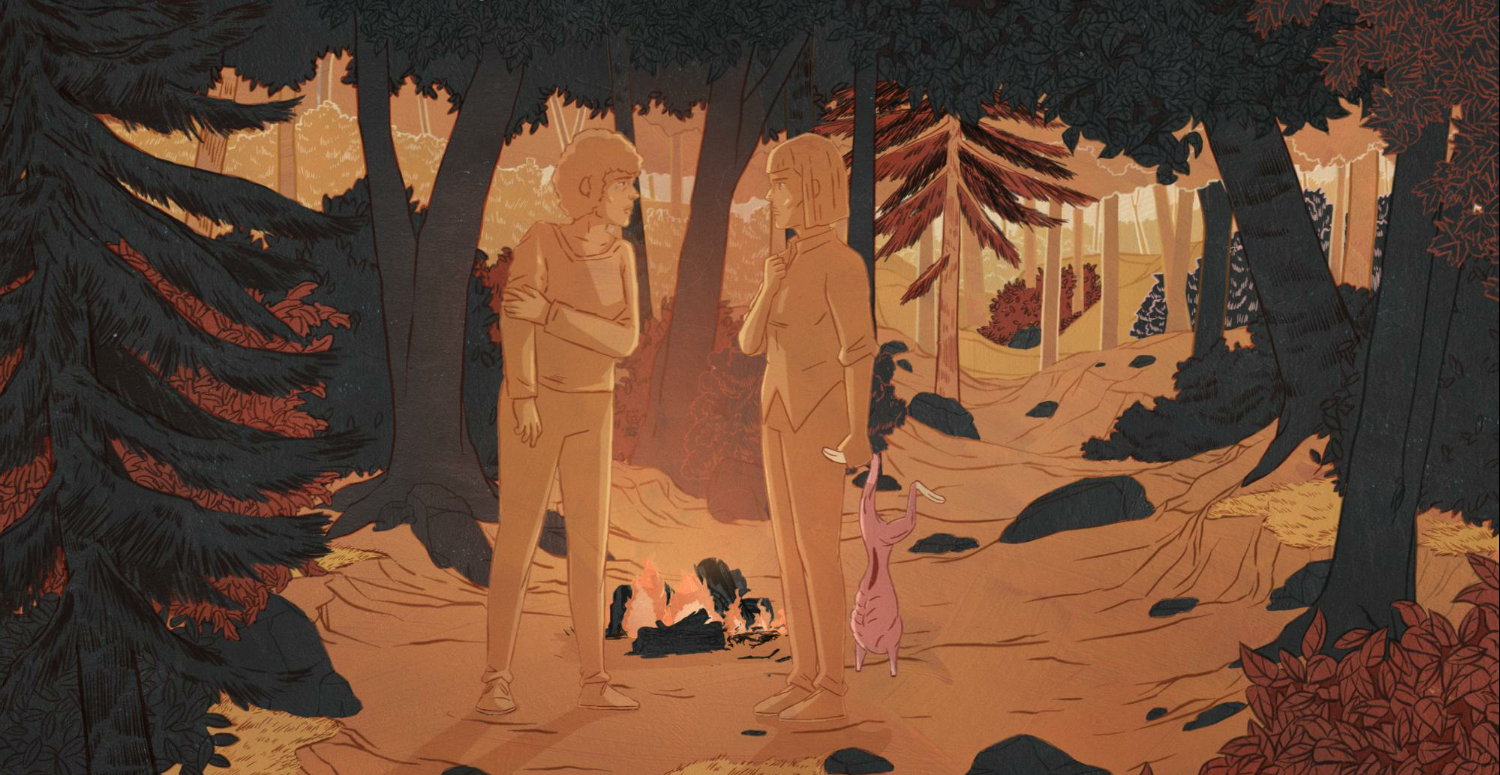
Si le film nous invite à de profondes introspections sur nos amitiés, nos amours, nos idéaux, nos valeurs et nos loyautés – et surtout sur leurs véritables implications et applications –, son image réellement impressionnante y est aussi pour beaucoup. Les dessins, ou plutôt les quasi-tableaux portés à l’écran sont constitués intégralement de séquences aux couleurs prononcées mais peu nombreuses – généralement de l’ordre de deux, trois ou quatre nuances (hormis pour quelques aplats monochromes). Les personnages, parfois verts, parfois rouges, parfois d’autres couleurs encore, se retrouvent ainsi fondus dans l’environnement qui les entoure, devenant presque transparents au profit d’un forêt vivante et aux détails faunistiques et floristiques qui ont leur importance.
Parce qu’outre la symbolique des arbres, des fleurs et des quatre animaux présents dans l’histoire (colibri, passereau, coyote, brebis), le long-métrage use d’une onirique ou d’ailleurs cauchemardesque dérive vers le fantastique, les métamorphoses, les projections de l’imagination d’une Hélène en proie à des émotions en tous genres, fortes et paradoxales. D’où un titre et une fin aussi métaphorique que le film est tout bonnement magnifique.
Axel Chevalier
Are our choices, however radical they may be, irreversible? “Death Does Not Exist” attempts to provide an answer to this question with a perspective that is both multifaceted and poetic. This animated film, directed by Quebecois filmmaker Félix Dufour-Laperrière and entirely hand-made (on a graphics pad), is striking both for its style and for the metaphysical, philosophical, and political issues it raises.
During the course of a violent incident coordinated by her and her friends, Hélène becomes frightened and abandons her group, fleeing into the woods. But she is offered a second chance, the opportunity to redeem herself, to consider a decision in the face of a difficult dilemma with heavy consequences, both for her and for the rest of the world. In this reflective and initiatory journey, the young woman can count on Manon, her close guardian angel-demon, who will try to open her eyes to the possibilities available to her.
While the film invites us to look deeply into our friendships, loves, ideals, values, and loyalties – and above all, their true implications and applications – its truly impressive visuals also have a lot to offer. The drawings, or rather the near-paintings brought to the screen, are made up entirely of sequences with strong colors but few in number – generally two, three, or four shades (except for a few monochrome patches). The characters, sometimes green, sometimes red, sometimes other colors, thus blend into their surroundings, becoming almost transparent in favor of a living forest with significant fauna and flora details.
Because, in addition to the symbolic nature of the trees, flowers, and the four animals featured in the story (hummingbird, passerine, coyote, sheep), the movie takes a dreamlike, even nightmarish, turn toward fantasy, metamorphosis, and the projections of Hélène’s imagination as she is overcome by all kinds of strong and paradoxical emotions. Hence a title and an ending as metaphorical as the film is simply beautiful.
Axel Chevalier