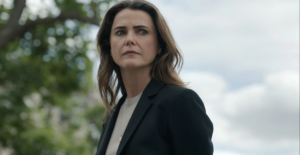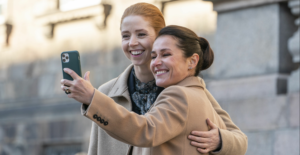

Dans un scénario de fiction s’inspirant de très nombreux éléments réels, cette série suisse revient sur les négociations qui se sont tenues entre 2013 et 2015 pour encadrer le programme nucléaire iranien alors que le régime était soupçonné de vouloir se doter de l’arme atomique et faisait face à de lourdes sanctions économiques asphyxiant son économie. « The Deal » raconte ainsi les coulisses du dernier round de négociations multilatérales sur les rives du lac Léman entre délégations iranienne, américaine, européenne, chinoise et russe sous l’égide de la Confédération helvétique qui coordonne ces échanges sous haute tension.
Sortie le même jour que la troisième saison de « The Diplomat » sur Netflix, cette mini-série Arte s’inscrit dans la lignée des séries politiques portées par des femmes dont « Borgen » reste l’étendard. Mais les deux séries de cet automne nous plongent dans un sous-genre d’autant plus complexe et périlleux (d’un point de vue scénaristique) à travers la diplomatie. Elles mettent en effet toutes deux des protagonistes féminins jouant un rôle de premier plan dans l’ombre de la géopolitique mondiale. Si chez Netflix, c’est au format ‘walk and talk’ très rythmé et maximaliste du Bureau ovale au 10 Downing Street, en passant au pas de charge de la chambre à coucher personnelle d’une ambassadrice à Air Force One. Ici c’est d’une manière bien plus intimiste, minimaliste et retenue que « The Deal » met en scène une discrète cheffe du protocole au cœur de la mission de facilitation helvétique qui héberge et encadre les négociations. Interprétée par l’actrice flamande Veerle Baetens (Alabama Monroe ; Plaine Orientale), cette diplomate suisse court de délégation en délégation, amadouant autant que possible les sensibilités et susceptibilités de chacun.

Mais si ce postulat narratif est intéressant et audacieux en interrogeant la place de la neutralité et en plaçant la protagoniste (presque) toujours en retrait et en observation des jeux d’influence et prises de décision qui se jouent lors de ces négociations, c’est aussi un choix qui ne permet pas nécessairement de rentrer immédiatement dans le vif du sujet. La première moitié s’avère ainsi assez lente, souffrant parfois de certains dialogues d’exposition trop soulignés ou inutiles mais mêlant néanmoins suffisamment d’intérêts variés – négociations diplomatiques, drame personnel, thriller d’espionnage – pour qu’une fois synchronisés, tous ces éléments construisent un véritable thriller diplomatique dans une seconde moitié palpitante. Si tout n’est pas parfaitement crédible ou intrigant, l’ensemble reste très réussi grâce à un fond intéressant et instructif, et une belle conclusion.
Entre huis-clos diplomatique et thriller intime, cette mini-série méticuleusement bien documentée et portée par un casting international et multilingue, reflète à la fois le travail de documentaires politiques de Jean-Stéphane Bron (Connu de nos services ; Cleaveland contre Wall Street) et le travail sur la place des femmes dans les lieux de pouvoir d’Alice Winocour (Proxima ; Revoir Paris). Les deux cinéastes montrent ainsi toute la complexité et la fragilité du processus diplomatique dont les accords reposaient encore sur des mots avant que le pur rapport de force ne l’emporte ces dernières années. Car si une négociation est bien un lieu d’affrontement, c’est avant tout une partie d’échec où l’on fait inévitablement un pas vers l’autre. Autrement dit, c’est l’art de confronter l’autre dans une réalité des faits pour éviter la guerre qui se joue aujourd’hui sur des faits alternatifs. Un art invisible mais crucial qui a depuis été balayé par le retrait américain d’une géopolitique mondiale multilatérale.
In a fictional scenario inspired by plenty of real events, this Swiss series revisits the negotiations that took place between 2013 and 2015 to regulate Iran’s nuclear program, at a time when the regime was suspected of trying to acquire nuclear weapons and was facing heavy economic sanctions that were crippling its economy. “The Deal” thus takes us behind the scenes of the final round of multilateral negotiations on the shores of Lake Geneva between Iranian, American, European, Chinese, and Russian delegations, under the auspices of the Swiss Confederation, which coordinated these highly tense discussions.
Released on the same day as the third season of “The Diplomat” on Netflix, this Arte miniseries joins the ranks of political series led by women, of which “Borgen” remains the gold standard. But this fall’s two series delve into a subgenre that is even more complex and challenging (from a screenwriting perspective) through the lens of diplomacy. Both feature female protagonists playing a leading role in the shadows of global geopolitics. While Netflix uses a fast-paced, maximalist “walk and talk” approach, moving quickly from the Oval Office to 10 Downing Street, or from an ambassador’s bedroom to Air Force One, “The Deal” takes a much more intimate, minimalist, and calm approach, portraying a discreet chief of protocol at the heart of Switzerland’s facilitation mission that hosts and oversees the negotiations. Played by Flemish actress Veerle Baetens (Alabama Monroe; Plaine Orientale), this Swiss diplomat runs from delegation to delegation, appeasing everyone’s sensitivities and susceptibilities as much as possible.
But while this storytelling approach is interesting and bold, questioning the role of neutrality and putting the main character (almost) always in the background, watching the power games and decision-making that happen during these negotiations, it’s also a choice that doesn’t necessarily get right to the heart of the matter. The first half is therefore rather slow, sometimes lagging with overly emphatic or unnecessary expositional dialogue, but nevertheless mixing enough different threads – diplomatic negotiations, personal drama, spy thriller – that once they come together, all these elements build to a solid diplomatic thriller in a thrilling second half. While not everything is perfectly credible or intriguing, the overall story is very satisfying thanks to an interesting and enlightening plot and a great ending.
Part diplomatic closed-door thriller, part intimate drama, this meticulously researched miniseries, featuring an international, multilingual cast, draws on both the work on political documentaries by Jean-Stéphane Bron (Known to our services; Cleveland versus Wall Street) and Alice Winocour’s work on women in positions of power (Proxima; Paris Memories). The two filmmakers thereby show the complexity and fragility of the diplomatic process, whose agreements were still based on words before the sheer power balance took over in recent years. For while negotiation is indeed a place of confrontation, it is above all a game of chess in which one inevitably takes a step towards the other. In other words, it is the art of confronting the other with the reality of facts in order to avoid the war that is currently being waged on the basis of alternative facts. This is an invisible but crucial craft that has since been swept away by the US withdrawal from multilateral global geopolitics.