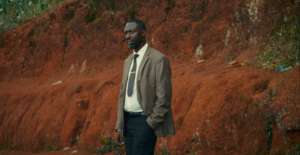
L’île rouge
(Red island)
2023

FR EN
Après le très acclamé « 120 battements par minute » – Grand Prix à Cannes en 2017 – où Robin Campillo nous plongeait au cœur d’Act Up et de la bataille contre le SIDA, il nous emmène cette fois-ci à Madagascar au sein de la base 181 de l’armée française en 1970 peu après l’indépendance du pays, à une époque où les stigmates de la colonisation sont encore bien présents.
Mais « L’île rouge » n’est pas un film historique, plutôt un souvenir modelé par l’œil de l’enfance où le scénariste, monteur et réalisateur s’inspire de sa propre enfance pour raconter un moment clé de l’Histoire, peu connu et peu raconté, mêlant la fin de l’enfance à celle des illusions coloniales. Tourné à hauteur d’enfant, le film narre ainsi la vie d’une famille française et montre l’aveuglement colonial, mais laisse finalement plus place aux sensations et perceptions de l’enfant qu’à un réquisitoire sur l’Empire français.
Cette nostalgie enfantine mêlée aux questions politiques sous-jacentes donne au film une atmosphère à la fois onirique et formaliste avec des scènes métaphoriques et une belle dose de mélancolie portée par la musique d’Arnaud Rebotini. Le protagoniste se rêve ainsi en super-héroïne d’une France qu’il n’a pas connue et qui est pour cela mise en scène en maquettes dans des séquences d’imaginaire fantasmé très inventives visuellement et plastiquement.
C’est une œuvre aboutie, avec un formidable casting (Charlie Vauselle, Nadia Tereszkiewicz, Quim Guitiérrez) restreint dans un format 4:3 sous l’œil de l’enfant : l’œil d’un observateur témoignant presque d’une culture et d’une époque, un œil figurant également la caméra de son réalisateur. Robin Campillo réutilise la méthode adoptée pour « 120 battements par minute », en abordant un sujet historique de société à travers plusieurs relations personnelles au sein d’un groupe homogène (militants, militaires). Mais le point de vue progresse cette fois tout au long du film en démarrant chez l’enfant – dans son imaginaire – pour se déporter sur l’adulte et enfin sur le peuple malgache en changeant d’optique dans sa dernière partie.
« L’île rouge » maintient un équilibre délicat entre intrigue intimiste et politique, entrelaçant souvenirs et sensations avec des faits historiques pour raconter la fin des illusions. C’est un conte dépourvu de manichéisme, retournant la nostalgie post-coloniale, et qui parle de révolution comme un adieu à l’enfance.
After the highly acclaimed “120 BPM” – Grand Prix at Cannes in 2017 – in which Robin Campillo took us into the heart of Act Up and the battle against AIDS, this time he brings us to Madagascar within French army base 181 in 1970 shortly after the country’s independence, at a time when the stigma of colonization is still very much alive.
But “Red Island” is not a historical film, rather a memory shaped by the eye of childhood, in which the writer, editor and director draws inspiration from his own childhood to relate a key moment in history, little known and little talked about, blending the end of childhood with that of colonial illusions. Shot from a child’s perspective, the film narrates the life of a French family and shows colonial blindness, but ultimately leaves more room for the child’s feelings and perceptions than for an indictment of the French Empire.
This childhood nostalgia, combined with the underlying political issues, gives the film both a dreamlike and formalist mood, with metaphorical scenes and a good dose of melancholy driven by Arnaud Rebotini’s score. The protagonist dreams of himself as a superheroine of a France he has never known, which is therefore depicted in models in visually and plastically inventive fantasy sequences.
This is a fully realized work, with a wonderful cast (Charlie Vauselle, Nadia Tereszkiewicz, Quim Guitiérrez) confined to a 4:3 aspect ratio under the eye of a child: the eye of a keen observer, almost bearing witness to a culture and an era, an eye that is also the director’s camera. Robin Campillo reuses the approach he adopted for “120 BPM”, addressing a social historical issue through several personal relationships within a homogeneous group (militants, members of the military). This time, however, the point of view progresses throughout the film, starting with the child – in his imagination – then shifting to the adult, and finally to the Malagasy people, with a change of perspective in its final act.
“Red Island” delicately balances intimate and political intrigue, interweaving memories and feelings with historical facts to tell the story of the end of illusions. It’s a tale devoid of Manichaeism, turning post-colonial nostalgia upside down, and speaking of revolution as a farewell to childhood.