Undertone
2026
FR EN
Nouvelle pépite du cinéma d’horreur indépendant ? « Undertone » a dans tous les cas le mérite de présenter un certain cachet, ne serait-ce que dans sa conception. Premier long-métrage d’Ian Tuason (qui s’est à plusieurs reprises distingué pour ses productions sonores et en réalité virtuelle), le film s’inspire très fortement de la propre expérience du réalisateur – de sorte qu’il a même été intégralement tourné dans sa maison parentale.
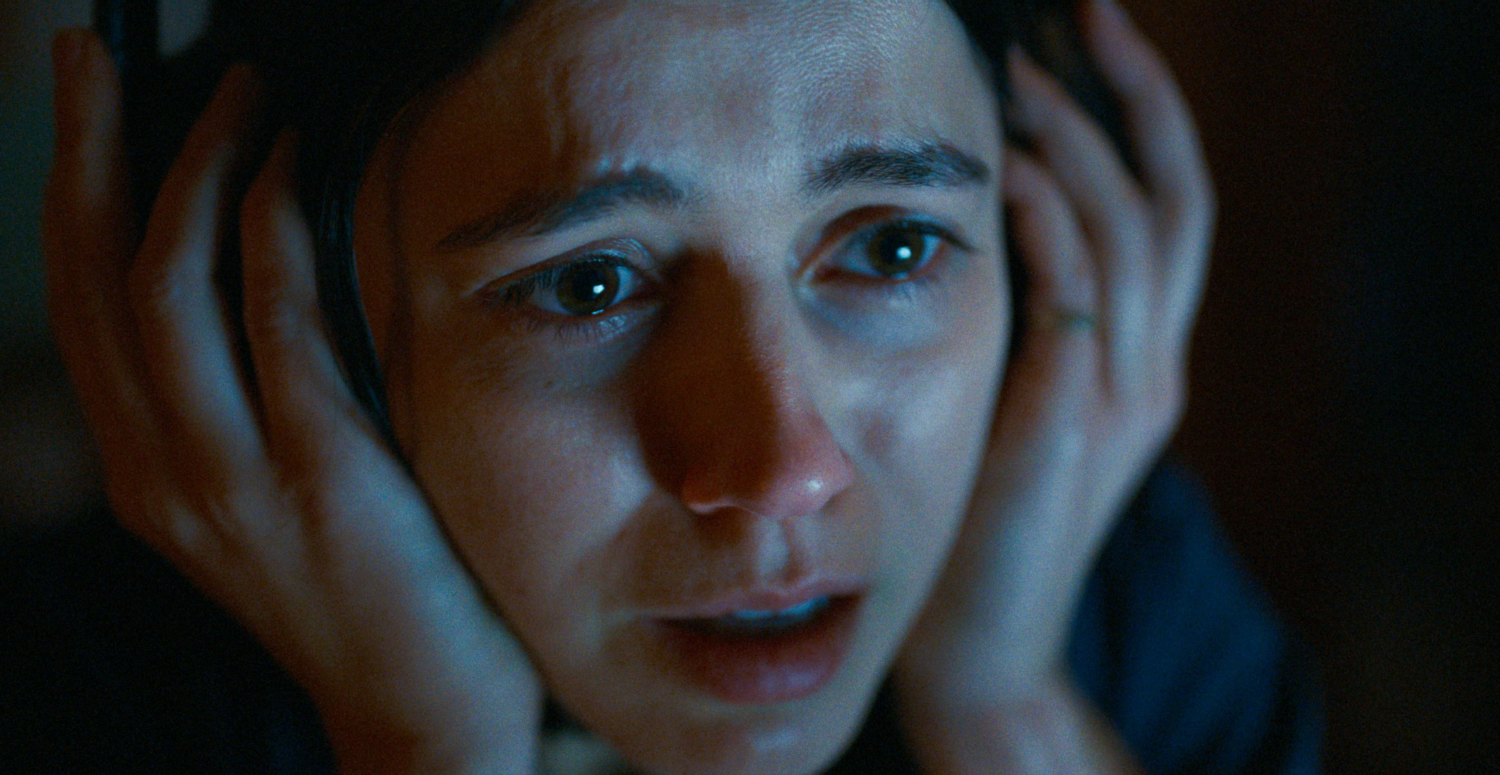
« Undertone » est donc un huis clos où l’on suit l’existence [r]enfermée d’Evy, podcasteuse sur le paranormal (vis-à-vis duquel elle est d’abord plutôt sceptique, contrairement à son acolyte) qui se vit chez sa mère en fin de vie, isolée. Elle reçoit un soir un courriel mystérieux auquel sont joints dix fichiers audios, et leur écoute va la faire basculer.
C’est tout un environnement sonore qu’Ian Tuason a créé pour ce film, avec des enregistrements volontairement dégradés, des appels téléphoniques de qualité aléatoire et d’autres sons plus banals que peut émettre toute maison, mais aussi avec des ruptures et des silences parfois plus assourdissants que le paradoxal vacarme qu’entend, semble entendre ou croit entendre Evy. De cette multiplicité acoustique, renforcée d’ailleurs sur le plan spatial avec cette demeure qui semble scindée en deux atmosphères visuelles, monte ainsi progressivement une angoisse augmentée par notre imagination, puisqu’il y a des parts d’ombre. C’est typique de ces incontournables creepypastas dont s’inspire ouvertement le film – qui a aussi pour références assumées « Le Projet Blair Witch » et « Paranormal Activity ».
Avec Evy, l’on passe alors doucement de la sur-rationalisation à l’épouvante, parce que les fichiers qu’elle analyse la nuit font de plus en plus écho à sa propre vie. La question de la maternité et des peurs qu’elle génère (autant sur la perte d’un parent que sur l’attente d’un enfant), entremêlée bien sûr à des éléments surnaturels, devient ainsi centrale. L’héroïne sombre logiquement dans une forme de folie, et la séquence finale, qui s’avère très intense, amène à une conclusion particulièrement brouillée mais originale – ce qu’est résolument le concept du film.
Axel Chevalier
A new gem in independent horror cinema? “Undertone” certainly has the merit of possessing a certain flair, if only in its design. Ian Tuason’s debut feature film (he has made a name for himself on several occasions with his sound and virtual reality productions) draws heavily on the director’s own experiences – so much so that it was shot entirely in his parents’ home.
“Undertone” is, therefore, a closed-door drama in which we follow the isolated life of Evy, a podcaster who covers the paranormal (toward which she is initially rather skeptical, unlike her fellow podcaster), who is living with her mother, who is nearing the end of her life, in isolation. One evening, she receives a mysterious email with ten audio files attached, and listening to them will turn her world upside down.
Ian Tuason has created an entire soundscape for this film, featuring deliberately degraded recordings, phone calls of varying quality, and other more mundane sounds that any home might make, but also featuring breaks and silences that are at times more deafening than the paradoxical noise that Evy hears, seems to hear, or thinks she hears. From this acoustic multi-layered effect – further reinforced spatially by the house, which seems split into two distinct visual realms – a sense of anxiety gradually builds, amplified by our imagination, as there are areas left in the shadows. This is typical of those classic creepypastas that the film openly draws inspiration from – as well as “The Blair Witch Project” and “Paranormal Activity”.
With Evy, we gradually shift from over-rationalization to terror, because the files she analyzes at night increasingly mirror her own life. The theme of motherhood and the fears it inspires (regarding both the loss of a parent and the anticipation of a child), intertwined, of course, with supernatural elements, thus takes center stage. The heroine logically descends into a form of madness, and the final sequence – which proves to be very intense – leads to a particularly muddled yet original conclusion – which is precisely what the film’s concept is all about.
Axel Chevalier