
Die My Love
Best Cinematography – BIFA
Best Music Supervision – BIFA
Best Cinematography – Ireland
2025/2026
FR EN
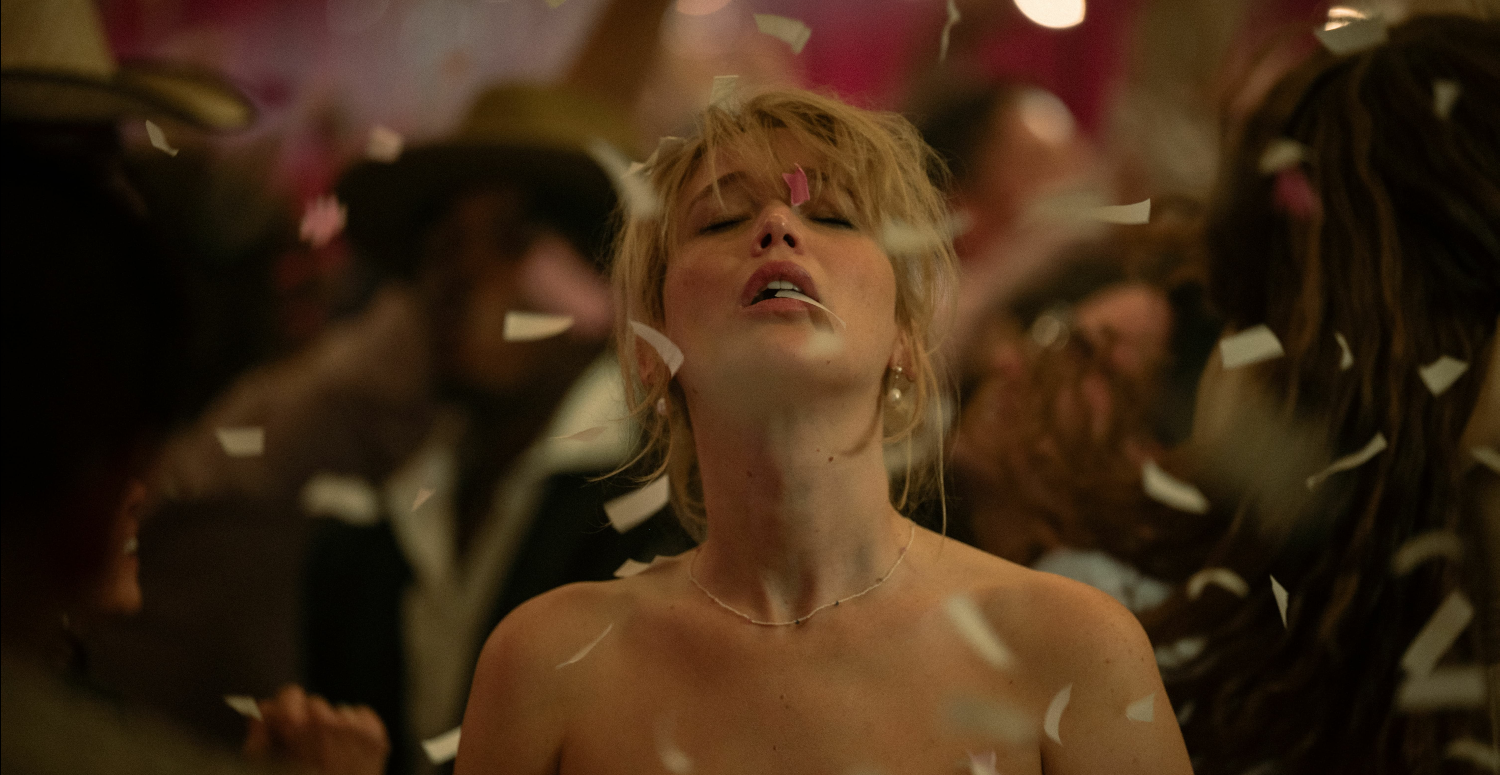
Brut, « Die My Love » est un drame (au soupçon d’humour noir) assez étonnant. Entièrement conçu comme étant une transmission fidèle des perceptions et des errances mentales de son personnage principal, le film se veut en effet très sensoriel. Le son – la musique, les bruits de la nature, le brouhaha humain – et les couleurs – qui d’ailleurs varient en fonction des humeurs de l’héroïne – se veulent filtrés par un premier rôle impertinent, spontané, animal, qui voit son état se dégrader à petits feux.
L’histoire est celle de Grace (Jennifer Lawrence) qui quitte New York avec son compagnon (Robert Pattinson) afin de fonder un foyer très (en fait trop) tranquille dans le Montana. Après son accouchement, en proie à un profond ennui doublé d’isolement (malgré l’arrivée d’un nouveau-né qu’elle chérit), la femme, déjà assez anti-conventionnelle, perd peu à peu la raison. Elle se sent frustrée, bloquée, ne ressent plus rien sinon du vide. Une dépression post-partum y est certainement pour quelque chose, mais ce mal-être paraît plus profond encore.
Le long-métrage, à l’instar du livre dont il est inspiré, brouille ainsi volontairement les temporalités, de sorte que l’on ne se fie plus qu’aux sensations, instincts et délires de Grace, enfermée dans une ancienne ferme au milieu de nulle part et/puis enfermée dans ses derniers relents d’émotions. « Die My Love », fondamentalement dramatique, se montre ainsi aussi décalé que son héroïne, et le souligne avec une patte visuelle et sonore immersive, où l’environnement (notamment la maison) devient un personnage à part entière – bien plus présent que le conjoint souvent absent et totalement déconnecté de la réalité de Grace. Le résultat en est un film déroutant et laissant circonspect mais qui fait réfléchir tant aux conséquences de la maternité chez les femmes qu’à celles de l’isolement de la ruralité.
Axel Chevalier
Raw and edgy, “Die My Love” is a rather surprising drama (with a touch of dark humor). Designed entirely as a faithful portrayal of its main character’s perceptions and mental wanderings, the film is, in fact, highly sensory. The sound – the music, the sounds of nature, the human hubbub – and the colors – which, incidentally, shift according to the heroine’s moods – are filtered through a sassy, spontaneous, animalistic lead character who watches her state of mind slowly slip away.
The story follows Grace (Jennifer Lawrence), who leaves New York with her partner (Robert Pattinson) to start a very (in fact, too) quiet life in Montana. After giving birth, plagued by profound boredom compounded by isolation (despite the arrival of a newborn she dearly loves), the woman – already quite unconventional – gradually loses her mind. She feels frustrated, stuck, and feels nothing but emptiness. Postpartum depression certainly plays a role, but this malaise seems even deeper.
Like the book it is based on, the film deliberately blurs the sense of time, so that we come to rely solely on the sensations, instincts, and delusions of Grace, who is trapped in an old farmhouse in the middle of nowhere and/or trapped within the last remnants of her emotions. Fundamentally dramatic, “Die My Love” is as quirky as its heroine, and underscores this with an immersive visual and sound design, where the environment (particularly the house) becomes a character in its own right – far more present than the often-absent husband, who is completely disconnected from Grace’s reality. The result is a disorienting film that leaves one cautious but thought-provoking, prompting reflection on both the consequences of motherhood for women and those of rural isolation.
Axel Chevalier