Train Dreams
Best Film – Spirit
Best Director – Spirit
Best Cinematography – Spirit
Actor’s Award – Camerimage & Middleburg
2025

FR EN
Présenté à Sundance et directement distribué sur Netflix, « Train Dreams » est une œuvre lumineuse et apaisante, aussi douce qu’âpre, un film intemporel comme un long chemin sur des rails où l’on se sent bien sans trop savoir où l’on va. C’est le portrait d’un bûcheron qui mène une paisible existence dans l’Amérique en pleine mutation du début du XXe siècle.
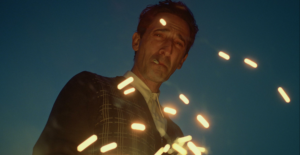
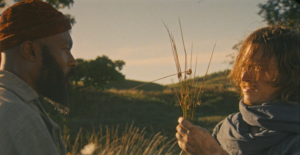
Magnifiquement joué par Joel Edgerton (Loving ; Warrior) – aux côtés de Felicity Jones (The Brutalist), William H. Macy (Fargo) et Kerry Condon (Les Banshees d’Inisherin) – le film de Clint Bentley se met au diapason de son protagoniste très silencieux et tranquille dans un rythme lent et une belle musique de Bryce Dessner. Et à l’image de ce personnage qui s’efforce tout du long d’être en phase avec sa vie, le film partage au spectateur sa communion avec la nature dans une splendide photographie d’Adolpho Veloso. Au gré de plans presque fixes – légèrement instables mais immobiles – d’une caméra portée qui conserve ses cadres tout en laissant comme une paisible brise les traverser, d’une lumière naturelle de chaque instant, et d’un format 3 :20 d’époque, « Train Dreams » filme les champs, les arbres, et les ciels dans un style parfois impressionniste presque malickien sublimant la magie de la Nature.
Plus un film de forme que de fond, « Train Dreams » n’oublie cependant pas de raconter l’humain à travers l’histoire d’un couple et d’une vie. Dans une narration en grande partie en voix-off, la trame parle tout autant en filigrane d’un pays et d’une époque charnière entre industrialisation, immigration et conquête des grands espaces, que d’un homme ordinaire qui ne laissera pas de traces dans une vie d’itinérance, une vie digne d’être vécue dont un poids distant pèse sur le récit. C’est une chronique du passé qui confronte avec poésie le vécu avec les autres, la solitude, la culpabilité et l’évolution des générations. C’est le récit d’une simplicité, le récit d’une épure, le récit d’un vivant.
Raphaël Sallenave
Presented at Sundance and distributed directly on Netflix, “Train Dreams” is a luminous and soothing film, as gentle as it is harsh, a timeless work like a long journey on rails where you feel good without really knowing where you are going. This is the portrait of a logger who leads a peaceful existence in the rapidly-changing America of the early 20th century.
Beautifully played by Joel Edgerton (Loving; Warrior) – alongside Felicity Jones (The Brutalist), William H. Macy (Fargo) and Kerry Condon (The Banshees of Inisherin) – Clint Bentley’s film echoes its very quiet and peaceful protagonist with a slow pace and beautiful music by Bryce Dessner. And, like this character who strives all along to connect with his life, the film connects the viewer with nature through Adolpho Veloso’s gorgeous cinematography. With almost static shots – slightly unstable but motionless – from a handheld camera that keeps its framing while letting a peaceful breeze blow through, natural light throughout, and a vintage 3:20 aspect ratio, “Train Dreams” captures fields, trees, and skies in a style that is sometimes impressionistic, almost Malickian, transcending the magic of Nature.
More a film of style than substance, “Train Dreams” nonetheless manages to tell a human story through the tale of a couple and of a lifetime. In a narrative largely told through voice-over, the plot speaks as much about a country and a pivotal era between industrialization, immigration, and the conquest of the great expanses, as it does about an ordinary man who will leave no trace behind in a life of wandering, a life worth living, whose distant burden weighs upon the story. It is a chronicle of the past that poetically explores experiences with others, loneliness, guilt, and the evolution of generations. This is a story of simplicity, a story of a pared-down life, a story of a living.
Raphaël Sallenave