

Le pitch est simple et efficace : comment réagirait la chaîne de commandement lorsqu’un missile nucléaire intercontinental est tiré en direction des USA. Une course contre la montre s’engage alors à tous les échelons de commandement pour tenter de comprendre la situation, y réagir et établir une potentielle réponse. Ce missile est-il bien réel ? Qui est donc à l’origine de l’attaque ? Quelles en seront les conséquences ? Mais si toutes ces questions tiraillent bien l’ensemble des personnages de ce thriller nucléaire, son sujet n’est pourtant pas là, car c’est plus dans la procédure et son impact sur les humains qui l’appliquent que le cœur du film se trouve.
La première réalisatrice oscarisée (pour « Démineurs » en 2009) continue donc de s’attaquer aux grands sujets de son pays, après la traque de Ben Laden (Zero Dark Thiry) et les émeutes raciales (Detroit). Et à l’heure où le débat nucléaire a été réactivé en Ukraine au sein d’un cercle désormais composée de neuf puissances dotées, la peur d’un affrontement atomique refait ici surface après s’être désagrégé à la fin de la guerre froide. « A House of Dynamite » s’inscrit ainsi dans cette veine de films de guerre froide (WarGames ; USS Alabama ; Le jour d’Après ; (et bien sûr) Docteur Folamour) qui visait à alerter sur cet ‘équilibre de la terreur’. Les prémices de l’intrigue évoquent d’ailleurs grandement le film de Sidney Lumet « Point Limite ». Mais là où ce dernier construisait un dilemme moral sur un enjeu avant tout psychologique, le film de Kathryn Bigelow diffusé sur Netflix, met plutôt en scène sous la forme d’un kaléidoscope, une visioconférence du chaos. Maîtrisant toujours aussi bien les sujets explosifs, elle signe un chef d’œuvre de tension à la fois étouffant, éprouvant et palpitant dont la nervosité et le sentiment d’urgence maintiennent en haleine tout du long.
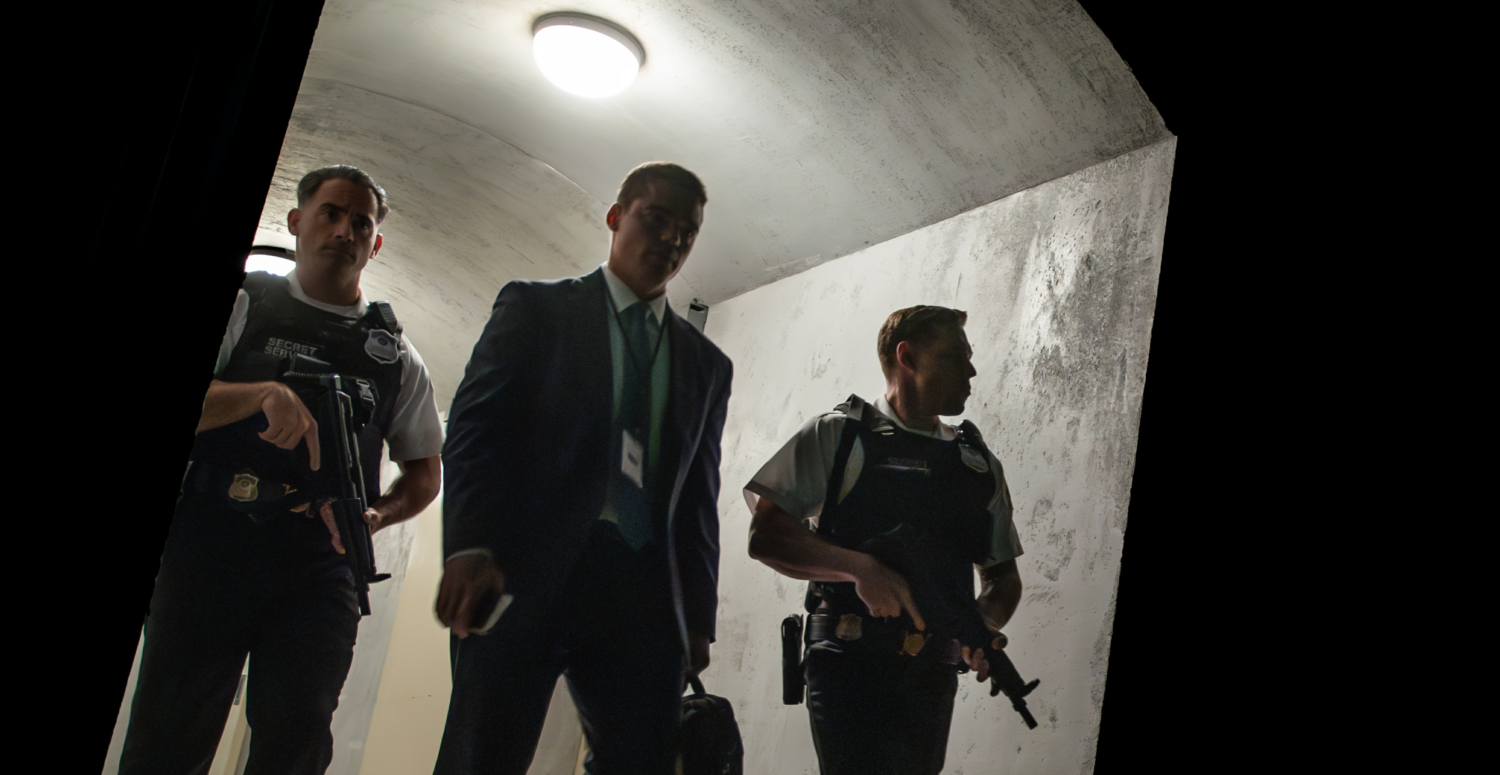
Si l’intrigue est bien fictive, elle s’appuie sur le contexte géopolitique actuel dans un souci du détail et un hyperréalisme saisissant. Jouant à la frontière entre fiction et réalité, l’intrigue se déroule ainsi sur une unique matinée et plus précisément sur 19 minutes chronométrées et suspendues dans le temps qui séparent l’identification de la menace du point d’impact du missile sous trois angles différents. Cette structure en trois temps permet de multiplier et de télescoper les points de vue sur ce même événement vécu en quasi temps réel. A chaque acte son lieu, son théâtre de parole et d’âpres négociations. Cette narration fragmentée donne ainsi une vision globale de la situation pour explorer l’ensemble de la chaîne de réponse dans une échelle hiérarchique débutant à l’étage de la surveillance pour atteindre celui de la décision avec un Président dont en entendait jusque-là seulement la voix. C’est en cela une forme de huis-clos décisionnel qui revient inlassablement sur les faits et les choix sans jamais paraître répétitif. Mais à mesure que ce cycle recommence, ce dispositif se détourne du suspense avant tout présent dans le premier acte, pour se concentrer sur les protocoles de crise car plus que l’arme atomique elle-même, les vrais grands dangers de cette histoire sont le pouvoir de décision unique et le temps de réaction de la chaîne de réponse.
Dans un cadre extrêmement précis et documenté, et un brassage continu de courts plans caméra à l’épaule signés Barry Ackroyd (chef opérateur de Ken Loach à ses débuts puis notamment de Paul Greengrass et de Kathryn Bigelow), le scénario de Noah Oppenheim (Jackie) dissèque ainsi les rouages de cette chaîne de réaction prise dans un effet de circulation puis d’accumulation et enfin de saturation d’informations. C’est un thriller qui se transforme en film procédural dont tous les personnages qu’ils soient ‘principaux’ ou ‘secondaires’ n’ont droit qu’à un développement minimal en dehors de l’intrigue dans la mesure où ils sont, chacun dans leur propre logique, aspirés par l’examen des faits.

Cette somme d’individualités travaillant ensemble pour une décision qui les dépasse est se reflète dans un impressionnant casting impeccablement interprété (entre autres) par Rebecca Ferguson, Anthony Ramos, Jason Clarke, Greta Lee, Gabriel Basso, Tracy Letts, Jared Harris et Idris Elba dont les personnages disparaissent progressivement dans un rigoureux processus qui n’a jamais été pensé pour y appréhender la dimension humaine en son sein. L’armée c’est du protocole, de nombreux officiers passent leur carrière à s’entraîner à ces scénarios improbables. Pourtant celui à qui appartient seul, la décision finale, ne s’entraîne pas. Au-delà d’un réalisme technique et procédural, le film met ainsi en lumière le facteur humain d’une telle situation, et ici dans une administration qui plus est compétente. Il prend alors une tout autre dimension en y repensant dans le cadre de l’administration actuelle …
Si les portes laissées ouvertes par l’intrigue induiront nécessairement une légère frustration, le sujet n’est tout simplement pas là. Ce que Bigelow filme ici c’est l’impuissance au cœur de la puissance, en d’autres termes une maison pleine de dynamites qui remet en question le principe même d’une telle dissuasion. C’est un film sur un oubli collectif, sur l’illusion de contrôle, et le fantasme d’invincibilité des USA. Dans un montage dense rythmé par les compositions angoissantes de Volker Bertelmann (Conclave), le film se distingue par son scénario riche en dialogues authentiques et sa magistrale tension tout du long qui redéfinit le cinéma d’action. Intense et viscérale, l’action du film est ainsi réduite en hors-champ au décollage et à l’inclinaison d’une courbe, sans aucune menace visible ou antagoniste. Alliant les deux pôles de l’industrie cinématographique, « A House of Dynamite » s’impose ainsi à la fois comme un glaçant plaidoyer que comme un haletant divertissement.
Raphaël Sallenave
The premise is straightforward and compelling: how would the chain of command react when an intercontinental nuclear missile is launched toward the United States? A race against time unfolds at all levels of command as they attempt to understand the situation, react to it, and formulate a potential response. Is this missile real? Who is behind the attack? What will the fallout be? But while all these questions are certainly on every character’s mind in this nuclear thriller, that’s not really what the movie’s about. Instead, it’s more about the process and how it affects the people who put it into action.
The first woman to win an Oscar for Best Director (for “The Hurt Locker” in 2009) continues to tackle major issues in her country, after the hunt for Bin Laden (Zero Dark Thirty) and race riots (Detroit). And at a time when the nuclear debate has been reignited in Ukraine within a circle now made up of nine nuclear powers, the fear of an atomic confrontation is resurfacing after having dissipated at the end of the Cold War. “A House of Dynamite” is thus in line with Cold War films (“WarGames”; “USS Alabama”; “The Day After”; and, of course, “Dr. Strangelove”) that sought to warn about this ‘balance of terror’. The premise of the plot is also very reminiscent of Sidney Lumet’s film “Fail-Safe”. But where Lumet’s film built a moral dilemma around a primarily psychological issue, Kathryn Bigelow’s film, released on Netflix, instead depicts a kaleidoscopic videoconference of chaos. As skilled as ever at handling explosive subjects, she delivers a masterpiece of tension that is at once suffocating, harrowing, and thrilling, with a nervous energy and sense of urgency that keeps viewers on the edge of their seats throughout.
Although the plot is fictional, it draws on the current geopolitical context with striking detail and hyperrealism. Blurring the line between fiction and reality, it all takes place in a single morning, or more precisely over 19 minutes suspended in time between the identification of the threat and the missile’s point of impact, seen from three different perspectives. This three-part structure allows for multiple and overlapping points of view on the same event, experienced in near real time. Each act has its own location, its own stage for speech and bitter negotiations. This fragmented narrative thus provides an overview of the situation, exploring the entire reaction chain in a hierarchical scale, starting at the surveillance level to reach the decision-making level with a President whose voice we had only heard until then. In this sense, it is a form of closed-door decision-making that tirelessly revisits the facts and choices without ever feeling repetitive. But as this cycle starts all over again, the show moves away from the suspense that was so prominent in the first act to focus on crisis protocols because, more than the atomic weapon itself, the real dangers in this story are the single decision-making power and the chain of command’s reaction time.
In a highly meticulous and well-documented framework, with a steady stream of short handheld shots from Barry Ackroyd (Ken Loach’s cinematographer in his early days, then Paul Greengrass and Kathryn Bigelow’s as well) Noah Oppenheim’s (Jackie) screenplay examines the mechanics of this chain reaction, caught up in a cycle of circulation, accumulation, and finally saturation of information. It is a thriller that turns into a procedural film in which all the characters, whether ‘main’ or ‘supporting’, are given only minimal development outside the plot, as they are each, in their own way, drawn into the process.
This sum of individualities working together for a decision that far exceeds them is reflected in an impressive cast flawlessly interpreted (among others) by Rebecca Ferguson, Anthony Ramos, Jason Clarke, Greta Lee, Gabriel Basso, Tracy Letts, Jared Harris, and Idris Elba, whose characters gradually disappear in a rigorous process that was never designed to grasp the human dimension within it. The military is all about protocol, and many officers spend their careers training for these unlikely scenarios. Yet the person who alone has the final say does not train. Beyond technical and procedural realism, the film therefore highlights the human factor in such a situation, and in this case within an administration that is moreover quite competent. It then takes on a whole new dimension when viewed in the context of the present-day administration…
While the doors left open by the plot will surely generate some frustration, that’s simply not the point of the film. What Bigelow is addressing here is the powerlessness at the heart of power, in other words, a house full of dynamite that calls into question the very principle of deterrence. It is a film about a collective oblivion, about the illusion of control, and the fantasy of US invincibility. With dense editing to the rhythm of Volker Bertelmann’s (Conclave) haunting score, the film stands out for its authentic dialogue-heavy script and its masterful tension all the way, which redefines action cinema. The film’s intense and visceral action is reduced to off-screen takeoffs and flattening of inclination, with no visible threats or antagonists. Combining the two halves of the film industry, “A House of Dynamite” therefore proves to be both a chilling warning call and a breathless entertainment.
Raphaël Sallenave